

Clauda is a contemporary art gallery located in Prague’s Letná district. Founded in 2025 by Antonín Jirát. The gallery represents both emerging and established artists from the Czech Republic and abroad. Clauda has strong ties to the local cultural scene and actively helps artists forge connections with foreign markets and institutions.
Photo: Michal Ureš, 2025
Text: Emma Hanzlíková
Opening: June 19, 2026 / from 6p.m.
June 20 – July 18, 2026
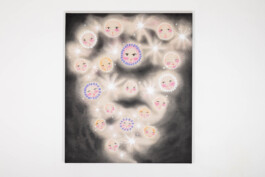
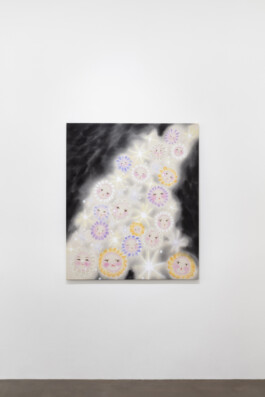
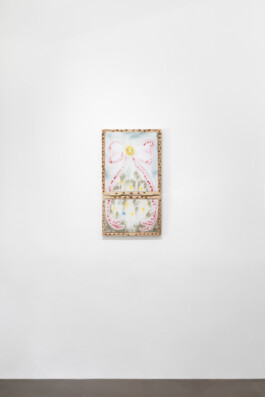
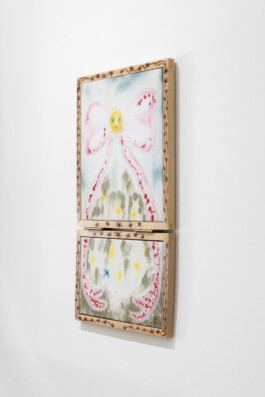
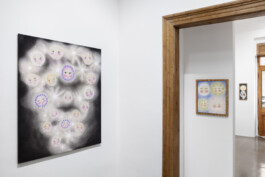
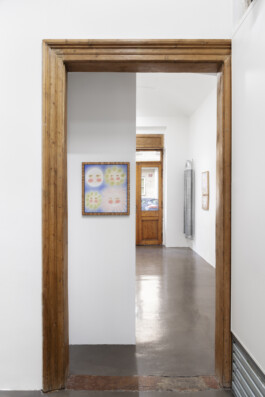
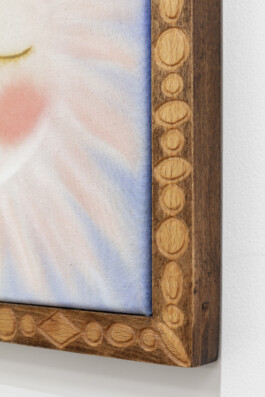
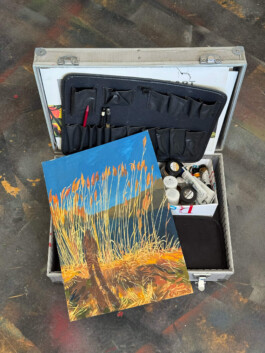
Olga Krykun, STARDUST FOR TOMORROW, 110 X 130 CM, ACRYLICS AND PASTEL ON CANVAS, 2026
Clauda is pleased to present new works by Olga Krykun in her exhibition Stardust for Tomorrow.
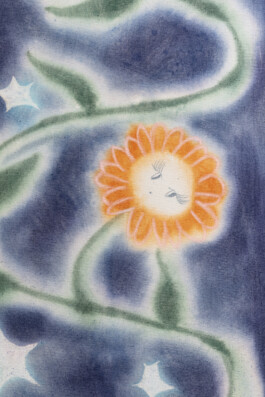
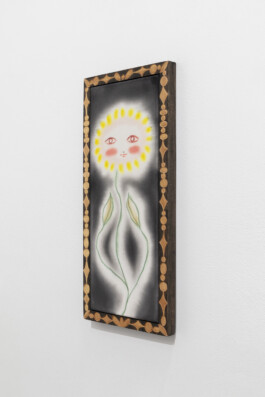
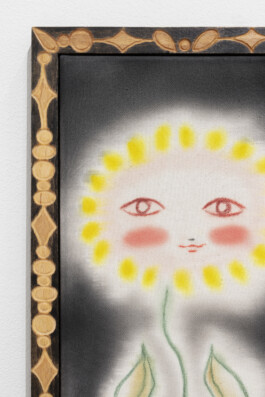
Although it may not be apparent at first glance, the smiling sunflowers painted by Olga Krykun (1994), a Czech artist of Ukrainian origin, conceal themes of war. The glittering flowers, melancholic girls’ faces with smudged makeup, and fluffy dogs evoking 1990s stationery are inspired by the kitschy souvenirs that are imported from Asia by the shipload and sold at the market in Krykun’s hometown of Odessa. A vision of unending war intertwines with the tacky aesthetics of Chinese trinkets in the artist’s washed paintings, which symbolize childlike innocence while at the same time making an urgent, emotional appeal for individuals to bring about radical changes in our society.
While it is tempting to view Krykun’s works in the context of the Japanese aesthetic of kawaii—a perspective further encouraged by her residencies in the cities of Matsudo and Yamanashi on the island of Honshu—this is not the only way to interpret them. Krykun’s painterly themes confirm that this naive, unconscious cuteness must be recognized as a highly ironic and critical commentary on contemporary society. The mechanism of cuteness relies on the viewer’s empathy, offering an apparent sense of security in exchange. The artist tells viewers a poetic story of comforting flowers, but upon closer inspection we discover that their stems are skeletons. Krykun’s paintings remind us of something we may have forgotten: that there is a thin line between cuteness and pain. Despite the lighthearted visuality evoking digital filters used to edit selfies into a Lolita-like aesthetic of pink hues and glitter, the motifs drawn from East Slavic folklore convey serious, authentic experiences connected with the invasion and occupation of Ukraine by the Russian regime.
The work Stardust for Tomorrow, whose title became the motif of the exhibition, embodies both joy and sorrow. On the one hand, soldiers who liberate a city from a tyrant are welcomed and crowned with flowers; on the other hand, flowers are placed on their graves. Flowers are used as symbols in ceremonies of both celebration and mourning. They are a part of life and death. For 1960s hippie culture they were an emblem of peace, accompanied by the famous slogan “Flowers, not bombs.” Just as flowers are fleeting, so too is dust or sand, which Buddhist monks spend days and weeks shaping grain by grain into elaborate mandala patterns, only to then scatter them with a single breath or sweep of the hand once completed. Delicate flowers and invisible stardust both evoke the Japanese concept of mono no aware, which is not far removed from the European understanding of vanitas. It is a plaintive, melancholic emotion evoked by things that are beautiful yet fleeting, such as elusive childhood memories, flowers, Chinese souvenirs, or freedom.
Emma Hanzlíková
_______________
Krykun uses a diverse array of media within her practice, including video, objects and painting, which she subsequently assembles to create complex installations. By combining elements of fictional narratives with references to cultural and socially relevant symbols, she invents a self-contradicting mythology of our day-and-age. Krykun’s work is heavily informed by her experiences growing up in her family’s souvenir shop during a swiftly globalizing 1990s Ukraine.
Her practice, which is strongly rooted in intuition and emotion, serves as a kind of poetry for the times we live in.
Exhibitions: Gemini Season (2025), Galerii NoD, Praha (2025), 427 Gallery, Riga (2023), Wanda Gallery, Varšava (2022), Skala Gallery, Poznaň (2022), Gallery Konstfack, Stockholm (2020) a City Surfer Office, Praha (2018).
Group exhibitions: Gen-Z, MO Museum in Vilnius (2026, Ulstrup Gallery, Dánsko (2025), MXM Galeria, Madrid (2025), DSC Gallery, Praha (2025), Muzeu moderního umění ve Varšavě (2023), Českém centru v Soulu (2022), Garage Gallery, Praha (2021) a v Yo-Chang Art Museum na Tchaj-wanu (2019).
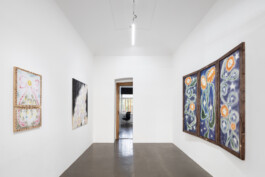
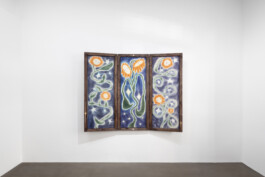
Text: Emma Hanzlíková
Opening: June 19, 2026 / from 6p.m.
June 20 – July 18, 2026
Olga Krykun, STARDUST FOR TOMORROW, 110 X 130 CM, ACRYLICS AND PASTEL ON CANVAS, 2026
Clauda is pleased to present new works by Olga Krykun in her exhibition Stardust for Tomorrow.
Although it may not be apparent at first glance, the smiling sunflowers painted by Olga Krykun (1994), a Czech artist of Ukrainian origin, conceal themes of war. The glittering flowers, melancholic girls’ faces with smudged makeup, and fluffy dogs evoking 1990s stationery are inspired by the kitschy souvenirs that are imported from Asia by the shipload and sold at the market in Krykun’s hometown of Odessa. A vision of unending war intertwines with the tacky aesthetics of Chinese trinkets in the artist’s washed paintings, which symbolize childlike innocence while at the same time making an urgent, emotional appeal for individuals to bring about radical changes in our society.
While it is tempting to view Krykun’s works in the context of the Japanese aesthetic of kawaii—a perspective further encouraged by her residencies in the cities of Matsudo and Yamanashi on the island of Honshu—this is not the only way to interpret them. Krykun’s painterly themes confirm that this naive, unconscious cuteness must be recognized as a highly ironic and critical commentary on contemporary society. The mechanism of cuteness relies on the viewer’s empathy, offering an apparent sense of security in exchange. The artist tells viewers a poetic story of comforting flowers, but upon closer inspection we discover that their stems are skeletons. Krykun’s paintings remind us of something we may have forgotten: that there is a thin line between cuteness and pain. Despite the lighthearted visuality evoking digital filters used to edit selfies into a Lolita-like aesthetic of pink hues and glitter, the motifs drawn from East Slavic folklore convey serious, authentic experiences connected with the invasion and occupation of Ukraine by the Russian regime.
The work Stardust for Tomorrow, whose title became the motif of the exhibition, embodies both joy and sorrow. On the one hand, soldiers who liberate a city from a tyrant are welcomed and crowned with flowers; on the other hand, flowers are placed on their graves. Flowers are used as symbols in ceremonies of both celebration and mourning. They are a part of life and death. For 1960s hippie culture they were an emblem of peace, accompanied by the famous slogan “Flowers, not bombs.” Just as flowers are fleeting, so too is dust or sand, which Buddhist monks spend days and weeks shaping grain by grain into elaborate mandala patterns, only to then scatter them with a single breath or sweep of the hand once completed. Delicate flowers and invisible stardust both evoke the Japanese concept of mono no aware, which is not far removed from the European understanding of vanitas. It is a plaintive, melancholic emotion evoked by things that are beautiful yet fleeting, such as elusive childhood memories, flowers, Chinese souvenirs, or freedom.
Emma Hanzlíková
_______________
Krykun uses a diverse array of media within her practice, including video, objects and painting, which she subsequently assembles to create complex installations. By combining elements of fictional narratives with references to cultural and socially relevant symbols, she invents a self-contradicting mythology of our day-and-age. Krykun’s work is heavily informed by her experiences growing up in her family’s souvenir shop during a swiftly globalizing 1990s Ukraine.
Her practice, which is strongly rooted in intuition and emotion, serves as a kind of poetry for the times we live in.
Exhibitions: Gemini Season (2025), Galerii NoD, Praha (2025), 427 Gallery, Riga (2023), Wanda Gallery, Varšava (2022), Skala Gallery, Poznaň (2022), Gallery Konstfack, Stockholm (2020) a City Surfer Office, Praha (2018).
Group exhibitions: Gen-Z, MO Museum in Vilnius (2026, Ulstrup Gallery, Dánsko (2025), MXM Galeria, Madrid (2025), DSC Gallery, Praha (2025), Muzeu moderního umění ve Varšavě (2023), Českém centru v Soulu (2022), Garage Gallery, Praha (2021) a v Yo-Chang Art Museum na Tchaj-wanu (2019).
Author's text
Opening: May 14, 2026 / from 6p.m.
May 15 – June 13, 2026
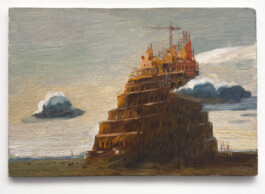
Alexey Klyuykov, TOWER, 20X13CM, OIL ON PANEL, 2026
Disrupted Horizon presents a cross section of paintings on the border between construction and disintegration. Fragments of construction sites, landscapes, and ruins come together to form images in which reality is slightly skewed.
In the background a sense of disorientation emerges—the moment when faith wanes, leaving nothing but silent wandering through the space between what remains unfinished and what has already ceased to exist.
Alexey Klyuykov (*1983, Vladimir, RU) is an artist and illustrator. He has long collaborated with Vasil Artamonov, and as a duo they won the 2010 Jindřich Chalupecký Award. Klyuykov focuses predominantly on painting, with an interest in the concept of realism in twentieth-century art as well as its contemporary possibilities.
He has collaborated as an illustrator with a range of periodicals, publishing houses, cultural institutions, and architecture studios. He lives and works in Prague.
Representation in collections: National Gallery Prague, Prague City Gallery, Gallery of Modern Art in Hradec Králové
Selection of exhibition projects: Lessons from Realism, Display, Prague, 2024, Manuš Means Human, Kunsthalle Wien, 2021 (with the Averklub Collective), Dead and Alive, 9th Triennale of Contemporary Art U3, Ljubljana, 2019, Jiwa, Jakarta Biennale, 2017, 2076, OGV, Jihlava, 2011, Clay Flag, Cripta747, Torino, 2009
Author's text
Opening: May 14, 2026 / from 6p.m.
May 15 – June 13, 2026
Alexey Klyuykov, TOWER, 20X13CM, OIL ON PANEL, 2026
Disrupted Horizon presents a cross section of paintings on the border between construction and disintegration. Fragments of construction sites, landscapes, and ruins come together to form images in which reality is slightly skewed.
In the background a sense of disorientation emerges—the moment when faith wanes, leaving nothing but silent wandering through the space between what remains unfinished and what has already ceased to exist.
Alexey Klyuykov (*1983, Vladimir, RU) is an artist and illustrator. He has long collaborated with Vasil Artamonov, and as a duo they won the 2010 Jindřich Chalupecký Award. Klyuykov focuses predominantly on painting, with an interest in the concept of realism in twentieth-century art as well as its contemporary possibilities.
He has collaborated as an illustrator with a range of periodicals, publishing houses, cultural institutions, and architecture studios. He lives and works in Prague.
Representation in collections: National Gallery Prague, Prague City Gallery, Gallery of Modern Art in Hradec Králové
Selection of exhibition projects: Lessons from Realism, Display, Prague, 2024, Manuš Means Human, Kunsthalle Wien, 2021 (with the Averklub Collective), Dead and Alive, 9th Triennale of Contemporary Art U3, Ljubljana, 2019, Jiwa, Jakarta Biennale, 2017, 2076, OGV, Jihlava, 2011, Clay Flag, Cripta747, Torino, 2009
May 21 – 24, 2026
Art warsaw Villa róŽ 2026
We are delighted to announce our participation at Art Warsaw 2026.
Artists:
Olga Krykun
Martin Groch
Šimon Sýkora
More at artwarsaw.com
Thanks to the Czech Center in Warsaw for its support.

OLGA KRYKUN, STARDUST FOR TOMORROW, 110 X 130 CM, ACRYLICS PASTEL, CANVAS, 2026
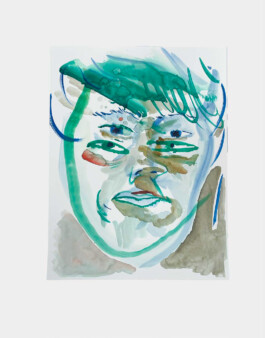
MARTIN GROCH, UNTITLED (FROM THE SERIES THEY ARE UGLY BECAUSE THEY ARE ANGRY) 24 X 30 CM, WATERCOLOR ON PAPER, 2025
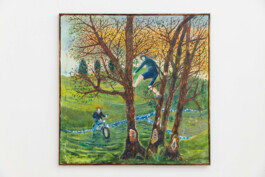
ŠIMON SÝKORA, UNKNOWN PLEASURES, 110 X 110 CM, OIL ON CANVAS, 2025
May 21 – 24, 2026
Art warsaw Villa róŽ 2026
We are delighted to announce our participation at Art Warsaw 2026.
Artists:
Olga Krykun
Martin Groch
Šimon Sýkora
More at artwarsaw.com
Thanks to the Czech Center in Warsaw for its support.
OLGA KRYKUN, STARDUST FOR TOMORROW, 110 X 130 CM, ACRYLICS PASTEL, CANVAS, 2026
MARTIN GROCH, UNTITLED (FROM THE SERIES THEY ARE UGLY BECAUSE THEY ARE ANGRY) 24 X 30 CM, WATERCOLOR ON PAPER, 2025
ŠIMON SÝKORA, UNKNOWN PLEASURES, 110 X 110 CM, OIL ON CANVAS, 2025
Curator Lenka Lindaurová
Opening: March 26, 2026 / 6PM – 9PM
March 27 – April 25, 2026
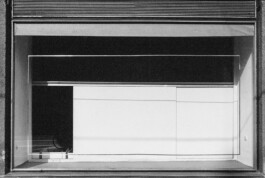
Iren Stehli, Prague Shop Windows, black and white photograph on baryta paper, 1978–1996
Clauda is pleased to present a solo exhibition of works by Swiss photographer Iren Stehli. This selection of photographs from an extensive collection spanning from the 1970s to today attempts to capture the timeless and poetic scenes of a single environment: city shop windows. Swiss photographer Iren Stehli, who found herself in Prague as a young student amidst the socialist aesthetics of scarcity and pettiness, recorded this environment with fascination—absurd human creativity and the charm of the unintended on the one hand and the indifference of the city’s inhabitants, herd mentality, and drabness on the other. In the period when the exhibited black-and-white photographs were taken, the main trend in analog photography was documentary. It conveyed information that was otherwise unavailable in a territory fenced off with barbed wire and closed to the media.
However, in the series Shop Windows Stehli departed from the model of the “hidden face of communist prosperity” and documented precisely what the regime boasted about and put on display. We deliberately removed politics from the selection: shop window displays supplemented their meager assortments of goods with portraits of communist statesmen, political slogans, and posters; later, in the 1990s, these were replaced by colorful prints displaying varieties of Western Coca-Cola, scantily clad beauties, or waving golden cats.
What remained? Pure beauty without intention, an empty existence, a poem without words, a message of Kafkaesque transformation. Removed from the context of the larger whole, which presents the viewer with a society unfit for living, our selection seems like the filigree of an enchanted eye. It is a document of its time, but—as already mentioned—a quite timeless one. The aim is to present the artist as a sensitive observer who works with a time-lapse approach and to find moments in her work that transcend the medium of photography. The exhibited selection present the artist—whose works in other series are filled with curious characters—as a demiurge of silent images where the only thing that remains of people is an emotional trace.
Iren Stehli (*1953 Zurich) went to Prague in 1972 to take a Czech language course for foreigners (her mother was Czech), and she later studied Slavic studies at Charles University. By chance, she fell in love with photography, and from 1974 to 1979 she studied at FAMU, where she made many lifelong friends, including the inspiring theorist Anna Fárová. Stehli was so enchanted by the Czech environment that she continued returning from Switzerland, and most of her independent work therefore relates to the Czech milieu (such as the famous series Dancing Lessons 1974–77, Fast-Food Fish 1976–77, Sláma, the Tailor 1976–81, Libuna 1974–2001, and Prague Shop Windows 1976–96).
She exhibited for the first time in 1978 at the legendary Činoherní klub, and since 1983 her work has appeared in numerous international exhibitions. In 2014, she had a solo exhibition entitled So nah, so fern at the renowned Fotostiftung Schweiz in Winterthur, and a year later her work was also presented at the Prague City Gallery. Iren Stehli’s portfolio also includes three publications of her own work. Her portfolio also includes three original publications.
Her photographs are held in many prestigious collections, including Centre Pompidou, Sammlung der Stadt Zürich, Sammlung der Stadt Biel, Moravian Gallery in Brno, and Prague City Gallery. After the Velvet Revolution in 1989, she became the director of Pro Helvetia, a foundation supporting Czech culture, which she led for eight years. She also applied for Czech citizenship, and she still divides her time between Zurich and Prague.

Iren Stehli, Prague Shop Windows, black and white photograph on baryta paper, 1978–1996
Curator Lenka Lindaurová
Opening: March 26, 2026 / 6PM – 9PM
March 27 – April 25, 2026
Iren Stehli, Prague Shop Windows, black and white photograph on baryta paper, 1978–1996
Clauda is pleased to present a solo exhibition of works by Swiss photographer Iren Stehli. This selection of photographs from an extensive collection spanning from the 1970s to today attempts to capture the timeless and poetic scenes of a single environment: city shop windows. Swiss photographer Iren Stehli, who found herself in Prague as a young student amidst the socialist aesthetics of scarcity and pettiness, recorded this environment with fascination—absurd human creativity and the charm of the unintended on the one hand and the indifference of the city’s inhabitants, herd mentality, and drabness on the other. In the period when the exhibited black-and-white photographs were taken, the main trend in analog photography was documentary. It conveyed information that was otherwise unavailable in a territory fenced off with barbed wire and closed to the media.
However, in the series Shop Windows Stehli departed from the model of the “hidden face of communist prosperity” and documented precisely what the regime boasted about and put on display. We deliberately removed politics from the selection: shop window displays supplemented their meager assortments of goods with portraits of communist statesmen, political slogans, and posters; later, in the 1990s, these were replaced by colorful prints displaying varieties of Western Coca-Cola, scantily clad beauties, or waving golden cats.
What remained? Pure beauty without intention, an empty existence, a poem without words, a message of Kafkaesque transformation. Removed from the context of the larger whole, which presents the viewer with a society unfit for living, our selection seems like the filigree of an enchanted eye. It is a document of its time, but—as already mentioned—a quite timeless one. The aim is to present the artist as a sensitive observer who works with a time-lapse approach and to find moments in her work that transcend the medium of photography. The exhibited selection present the artist—whose works in other series are filled with curious characters—as a demiurge of silent images where the only thing that remains of people is an emotional trace.
Iren Stehli (*1953 Zurich) went to Prague in 1972 to take a Czech language course for foreigners (her mother was Czech), and she later studied Slavic studies at Charles University. By chance, she fell in love with photography, and from 1974 to 1979 she studied at FAMU, where she made many lifelong friends, including the inspiring theorist Anna Fárová. Stehli was so enchanted by the Czech environment that she continued returning from Switzerland, and most of her independent work therefore relates to the Czech milieu (such as the famous series Dancing Lessons 1974–77, Fast-Food Fish 1976–77, Sláma, the Tailor 1976–81, Libuna 1974–2001, and Prague Shop Windows 1976–96).
She exhibited for the first time in 1978 at the legendary Činoherní klub, and since 1983 her work has appeared in numerous international exhibitions. In 2014, she had a solo exhibition entitled So nah, so fern at the renowned Fotostiftung Schweiz in Winterthur, and a year later her work was also presented at the Prague City Gallery. Iren Stehli’s portfolio also includes three publications of her own work. Her portfolio also includes three original publications.
Her photographs are held in many prestigious collections, including Centre Pompidou, Sammlung der Stadt Zürich, Sammlung der Stadt Biel, Moravian Gallery in Brno, and Prague City Gallery. After the Velvet Revolution in 1989, she became the director of Pro Helvetia, a foundation supporting Czech culture, which she led for eight years. She also applied for Czech citizenship, and she still divides her time between Zurich and Prague.
Iren Stehli, Prague Shop Windows, black and white photograph on baryta paper, 1978–1996
Curator Andrew Wilson
Opening: February 19, 2026 / 6PM – 9PM
Feb 20 – Mar 21, 2026
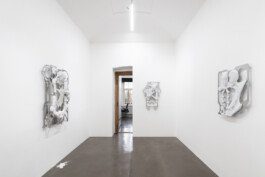
Paula Gogola, soft_sighs synthesis, Curator Andrew Wilson, photo: Eva rybářová
In the solo show soft_sighs synthesis, Paula Gogola presents a new series of works that, while departing from her usual medium of paint on canvas, rearticulate and metamorphose her motifs with a balance of strength and sensitivity. These intricately layered reliefs project Gogola’s brooding figures onto a three dimensional plane: dense muscularity unfurls into shrouded repose, razor edges of steel curve into soft, yawning angles. Cold rigidity bonds with openness, pulsating strength with discretion, temerity with fugitivity. Tensed between such polarities, the opaque vitality that marks Gogola’s expanding oeuvre is here intensified, where survival hinges on secrecy, consistency on transmutation.
“The imperative of transparency,” writes philosopher Byung-Chul Han, “suspects everything that does not submit to visibility. Therein lies its violence.” In the present, this imperative has become environmental, reproducing a systemic compulsion to exhibit, disclose, self-report. Algorithmic governance requires datasets abstracted from the soft tissue of bodies and the fragile folds of relations — discretized, compressed, knowable. This legibility becomes cruelty as the data feeds back, sticking to the surface of skins flagged for suspicion, abjection, erasure. For Gogola’s figures, seemingly contemplative and transfixed, conspicuous motion merely makes one a moving target. However, this veiled quietude does not signify withdrawal, but the drawing of battle lines elsewhere: beneath the hypervisible level of symbol and identity, and at that very infrastructural, procedural level of domination itself.
Édouard Glissant urges us to “agree not merely to the right to difference” — the highest virtue in a world where the appearance of difference keeps the engines of appropriation running — but “agree also to the right to opacity… subsistence within an irreducible singularity.” Concealment generates new interiorities, spaces of experimentation and transformation that transcend individual identity: “opacities can coexist and converge, weaving fabrics.” Facing one another with heads turned away, an intimate, possibly psychic communication transpires between the figures at the level of gesture, posture, inclination. A weave of opacity that bonds its communicants in an alliance whose means of survival, be it hiddenness, fugitivity, or subversion, is never mistaken for an end. Knowledge of that end, encrypted in prophecy and distributed in partial avowals, is foreclosed to those for whom knowledge is only ever instrumental. Yet this inaccessibility may also contain an invitation; a provocation to slip behind the darkening veil, to refuse the threshold of permissible existence…
Paula Gogola (*1998, Banská Bystrica) works primarily in the medium of painting. In the spirit of queer and feminist thinking, she observes the body as a changing form that is shaped by personal experience, cultural narratives, and speculative means. The main themes of her work include hormonal transformation, contamination, desire, and care, which she conveys through a delicate, atmospheric visual language. She received her bachelor's degree from Klaudia Kosziba's painting studio at the Academy of Fine Arts and Design in Bratislava. She completed her master's degree at the Painting 3 studio at the Academy of Fine Arts and Design in Prague under the guidance of Josef Bolfa and Jakub Hošek. During her studies, she completed several internships, both at the Academy of Arts, Architecture and Design in Prague (in Dominik Lang's sculpture studio and Michal Pěchouček and Dominik Gajarský's intermedia studio) and abroad at Beaux-Arts Paris (in a studio led by Mimosa Echard). Gogola has presented her work at numerous group exhibitions at home and abroad; for example, at Aurora Vessels at the ACUD Gallery in Berlin (2025), at Crash Club Projects in Warsaw (2024), and at the exhibition The rotten smell is you at Kunsthalle Bratislava (2023). She has presented her work independently at the exhibitions Leering Despondency (VUNU, Bratislava, 2024), Begone Estrone (together with Natália Sýkorová, Medium Gallery, Bratislava, 2025), and With feathers and flesh (together with Hanna Antonsson, Holešovická šachta, Prague, 2025). This year, she won first place in the 20th edition of the Slovak competition Maľba 2025.
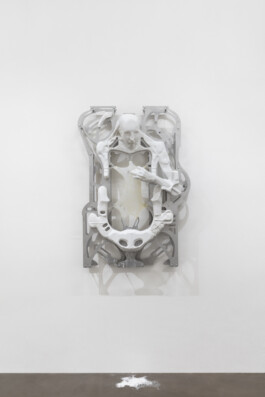
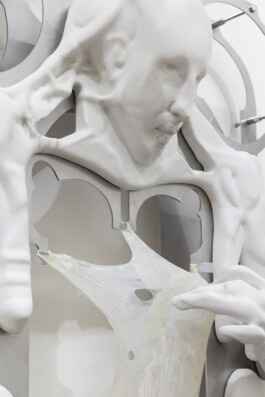
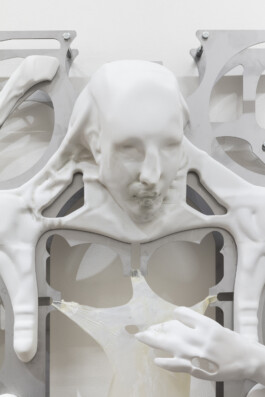
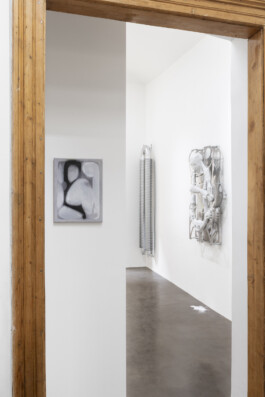
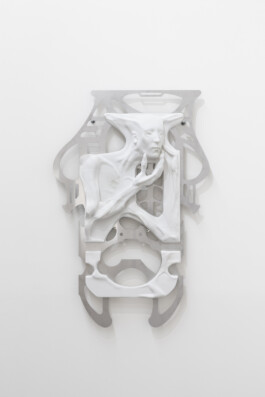
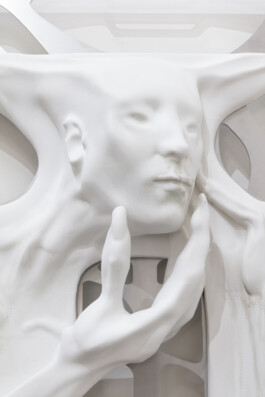
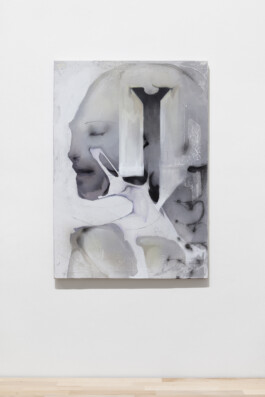
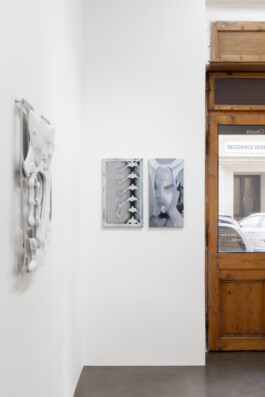
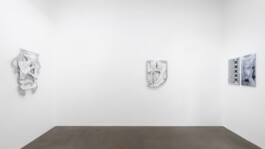
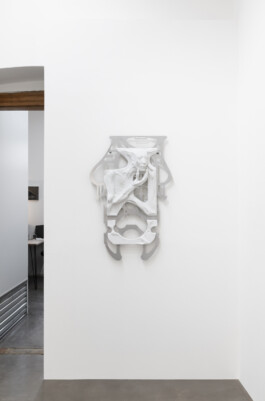
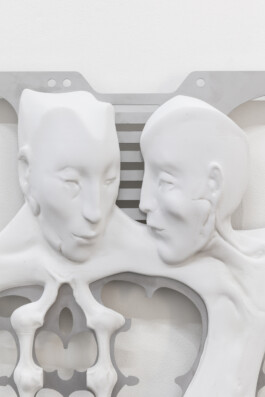
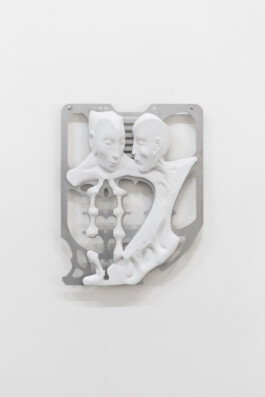
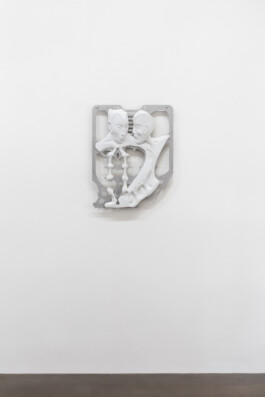
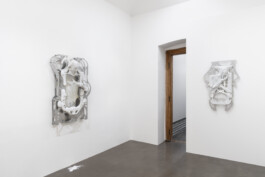
Paula Gogola, soft_sighs synthesis, Curator Andrew Wilson, photo: Eva rybářová
Paula Gogola, soft_sighs synthesis, Curator Andrew Wilson, photo: Eva rybářová
Paula Gogola, soft_sighs synthesis, Curator Andrew Wilson, photo: Eva rybářová
Paula Gogola, soft_sighs synthesis, Curator Andrew Wilson, photo: Eva rybářová
Paula Gogola, soft_sighs synthesis, Curator Andrew Wilson, photo: Eva rybářová
Paula Gogola, soft_sighs synthesis, Curator Andrew Wilson, photo: Eva rybářová
Paula Gogola, soft_sighs synthesis, Curator Andrew Wilson, photo: Eva rybářová
Paula Gogola, soft_sighs synthesis, Curator Andrew Wilson, photo: Eva rybářová
Paula Gogola, soft_sighs synthesis, Curator Andrew Wilson, photo: Eva rybářová
Paula Gogola, soft_sighs synthesis, Curator Andrew Wilson, photo: Eva rybářová
Paula Gogola, soft_sighs synthesis, Curator Andrew Wilson, photo: Eva rybářová
Paula Gogola, soft_sighs synthesis, Curator Andrew Wilson, photo: Eva rybářová
Paula Gogola, soft_sighs synthesis, Curator Andrew Wilson, photo: Eva rybářová
Paula Gogola, soft_sighs synthesis, Curator Andrew Wilson, photo: Eva rybářová
Curator Andrew Wilson
Opening: February 19, 2026 / 6PM – 9PM
Feb 20 – Mar 21, 2026
Paula Gogola, soft_sighs synthesis, Curator Andrew Wilson, photo: Eva rybářová
In the solo show soft_sighs synthesis, Paula Gogola presents a new series of works that, while departing from her usual medium of paint on canvas, rearticulate and metamorphose her motifs with a balance of strength and sensitivity. These intricately layered reliefs project Gogola’s brooding figures onto a three dimensional plane: dense muscularity unfurls into shrouded repose, razor edges of steel curve into soft, yawning angles. Cold rigidity bonds with openness, pulsating strength with discretion, temerity with fugitivity. Tensed between such polarities, the opaque vitality that marks Gogola’s expanding oeuvre is here intensified, where survival hinges on secrecy, consistency on transmutation.
“The imperative of transparency,” writes philosopher Byung-Chul Han, “suspects everything that does not submit to visibility. Therein lies its violence.” In the present, this imperative has become environmental, reproducing a systemic compulsion to exhibit, disclose, self-report. Algorithmic governance requires datasets abstracted from the soft tissue of bodies and the fragile folds of relations — discretized, compressed, knowable. This legibility becomes cruelty as the data feeds back, sticking to the surface of skins flagged for suspicion, abjection, erasure. For Gogola’s figures, seemingly contemplative and transfixed, conspicuous motion merely makes one a moving target. However, this veiled quietude does not signify withdrawal, but the drawing of battle lines elsewhere: beneath the hypervisible level of symbol and identity, and at that very infrastructural, procedural level of domination itself.
Édouard Glissant urges us to “agree not merely to the right to difference” — the highest virtue in a world where the appearance of difference keeps the engines of appropriation running — but “agree also to the right to opacity… subsistence within an irreducible singularity.” Concealment generates new interiorities, spaces of experimentation and transformation that transcend individual identity: “opacities can coexist and converge, weaving fabrics.” Facing one another with heads turned away, an intimate, possibly psychic communication transpires between the figures at the level of gesture, posture, inclination. A weave of opacity that bonds its communicants in an alliance whose means of survival, be it hiddenness, fugitivity, or subversion, is never mistaken for an end. Knowledge of that end, encrypted in prophecy and distributed in partial avowals, is foreclosed to those for whom knowledge is only ever instrumental. Yet this inaccessibility may also contain an invitation; a provocation to slip behind the darkening veil, to refuse the threshold of permissible existence…
Paula Gogola (*1998, Banská Bystrica) works primarily in the medium of painting. In the spirit of queer and feminist thinking, she observes the body as a changing form that is shaped by personal experience, cultural narratives, and speculative means. The main themes of her work include hormonal transformation, contamination, desire, and care, which she conveys through a delicate, atmospheric visual language. She received her bachelor's degree from Klaudia Kosziba's painting studio at the Academy of Fine Arts and Design in Bratislava. She completed her master's degree at the Painting 3 studio at the Academy of Fine Arts and Design in Prague under the guidance of Josef Bolfa and Jakub Hošek. During her studies, she completed several internships, both at the Academy of Arts, Architecture and Design in Prague (in Dominik Lang's sculpture studio and Michal Pěchouček and Dominik Gajarský's intermedia studio) and abroad at Beaux-Arts Paris (in a studio led by Mimosa Echard). Gogola has presented her work at numerous group exhibitions at home and abroad; for example, at Aurora Vessels at the ACUD Gallery in Berlin (2025), at Crash Club Projects in Warsaw (2024), and at the exhibition The rotten smell is you at Kunsthalle Bratislava (2023). She has presented her work independently at the exhibitions Leering Despondency (VUNU, Bratislava, 2024), Begone Estrone (together with Natália Sýkorová, Medium Gallery, Bratislava, 2025), and With feathers and flesh (together with Hanna Antonsson, Holešovická šachta, Prague, 2025). This year, she won first place in the 20th edition of the Slovak competition Maľba 2025.
Paula Gogola, soft_sighs synthesis, Curator Andrew Wilson, photo: Eva rybářová
Paula Gogola, soft_sighs synthesis, Curator Andrew Wilson, photo: Eva rybářová
Paula Gogola, soft_sighs synthesis, Curator Andrew Wilson, photo: Eva rybářová
Paula Gogola, soft_sighs synthesis, Curator Andrew Wilson, photo: Eva rybářová
Paula Gogola, soft_sighs synthesis, Curator Andrew Wilson, photo: Eva rybářová
Paula Gogola, soft_sighs synthesis, Curator Andrew Wilson, photo: Eva rybářová
Paula Gogola, soft_sighs synthesis, Curator Andrew Wilson, photo: Eva rybářová
Paula Gogola, soft_sighs synthesis, Curator Andrew Wilson, photo: Eva rybářová
Paula Gogola, soft_sighs synthesis, Curator Andrew Wilson, photo: Eva rybářová
Paula Gogola, soft_sighs synthesis, Curator Andrew Wilson, photo: Eva rybářová
Paula Gogola, soft_sighs synthesis, Curator Andrew Wilson, photo: Eva rybářová
Paula Gogola, soft_sighs synthesis, Curator Andrew Wilson, photo: Eva rybářová
Paula Gogola, soft_sighs synthesis, Curator Andrew Wilson, photo: Eva rybářová
Paula Gogola, soft_sighs synthesis, Curator Andrew Wilson, photo: Eva rybářová
Text by Persis Bekkering
Opening: December 18, 2025 / 6PM – 9PM
Dec 19, 2025 – Jan 31, 2026
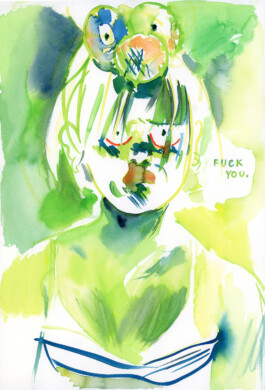
Martin Groch — They Are Ugly Because They Are Angry
The gallery is pleased to present a solo exhibition by Slovak-born artist Martin Groch. Groch currently lives in Brussels and works as an artist, cartoonist, and graphic designer. The exhibition features new works on paper titled They Are Ugly Because They Are Angry.
As part of the exhibition, Clauda will host the launch of After Giotto, Everything Went to Shit, a new publication by Persis Bekkering and Martin Groch, to be published by Utopia Libri.
BIO:
Martin Groch (1990)
is an artist, illustrator and graphic designer currently based in Brussels. Throughout his diverse practices, he is interested in the narrative expression of images, desiring to find explosive visual forms on the edge of the readable. He prefers to situate himself in the tradition of drawing and cartooning, even where he uses paint and brush, and feels strongly drawn to the publication form and the reproduced image. He is the author of Sweathearts (Abyme 2024), a typeface and comic book, published by his dear friend, the late John Morgan.
Born in Košice (Slovakia), Groch has been professionally active as a graphic designer and artist at least since 2013. He first trained in graphic techniques and typography, at Umprum in Prague among other institutions, which he left precociously. From 2019 to 2020, he was a resident at the Jan van Eyck Post-Academy for Art, Design and Reflection in Maastricht. Among his frequent collaborators are Tim+Tim Studio, Jakub Samek, Robert Jansa, Peter Bosák, and Nana Esi (Atelier Brenda).
At the invitation of prof. Natasha M. Llorens (KKH Royal Institute of Art Stockholm) in 2020, he participated in a project titled Art-Rite, reinterpreting the iconic cheap art newspaper from 70s New York. At KKH, Groch was also invited to give workshops and lectures. He has since taught at the Royal Academy of Arts Antwerp, Ensad Nancy, and in the current season, at HfG Karlsruhe. Previous exhibitions of his work include the Jan van Eyck Academy Maastricht, PLATO Ostrava, the Salone del Mobile Milan.
Persis Bekkering (NL)
is a writer and critic, engaging with a wide spectrum of artistic disciplines. She is interested in forms of expression that account for the permanence of crisis in the contemporary world. She is the author of two novels in Dutch, A Hero’s Life (2018, shortlisted for the ANV Debut Prize) and Excess (2021, shortlisted for the BNG Bank Prize for Literature). Her novella Last Utopia is published in English translation by the Jan van Eyck Academy Maastricht. As a writer, performer, conversation partner and dramaturge, she collaborates with artists such as Martin Groch, Dora García and Benjamin Abel Meirhaeghe. She also teaches creative writing at ArtEZ University of the Arts in Arnhem (NL).
.....
“Why are you drawing women so ugly?” my father asked me when I was a teenager. Around the same time, my mother remarked that drawing like this makes me one of those old men — she must have meant those sleazy, sad, or bankrupt ones from the generation of my father or older. Alcoholics, failed poets, bad fathers were around then as they are now. Both my parents must have been suspicious of what would become of me. I don't know what I answered them. I draw them like I find them most interesting.
I have been taught it is not good art to draw a black outline, to draw eyelashes, and that good artist should hold back when depicting that glitter in someone’s eyes. It was the late modernist tradition with an eastern Czechoslovak-Hungarian flavor I grew up with. That is inevitably a matter of the place and class one is born into; that was my first inheritance. And then I discovered comics. Suddenly I was invested in the opposite of the moderate, restricted modern style of painting (that style that which evidently was never meant to be restricted, but that's how it appeared to me, at that point in my life). I asked my father, who was a publisher at the time, if I could ever make money by applying ink on paper in order to create images, and he said – yes, sure.
Now I mostly use black brushstrokes. I draw make-up, jewelry, and hair, sometimes more visibly than any facial features, and my references are the kind of images meant to be read - cartoons, gothic paintings on wooden panels, or those characters in the mid-19th-century work of Wilhelm Busch, Max and Moritz. I love Krazy Kat, I like Yuichi Yokoyama and his “New Engineering,” where comics get as loud as they possibly can. I like American underground comics, I like those dancing, breathing, confused and overwhelmed characters which one might find in comics from Belgium, France, the States, Japan. There is something about that mechanical line.
I draw people as types or as specific people. I draw characters. Women, men, animals. Sometimes I doubt whether a typological depiction of figures is lazy — as I was being told —, but then again, typology is also a way of seeing, a way of catching something shared between people. Typology is not only repetition; it is also the place where the hand is balancing between something automatic and something inventive, between what is programmed and what aims to be free. Because otherwise — what is the alternative?
There is much debate about where to draw the line between drawing and painting, but I like to call what I do ‘drawing'. The history of drawing speaks to me the most. It is the closest I have come to writing. I'm always trying to hit that edge of readability. I often buy and consume a catalogue or a book accompanying a show, and that is what causes me the most joy. That is how I relate myself to so-called fine art. The format of a catalogue, a book with a reduced image quality, it tears off the aura of the work. The work of an artist is thrown into the mundane circulation of everyday life. Exciting. Reproduction flattens the work. Finally it becomes a picture plane I can orient myself in. I also feel drawn to the writing that comes with it – essays, interviews, captions. I tend to enjoy any art in that mixed form, sometimes more than the exhibition itself.
I am from a country where cartoon, as a practice, does not have its own name, and as a discipline no terms to work with. Cartooning is not reflected upon, exists just in fragments. One might aspire to be “karikaturista”, which means to do caricature, or to do “kreslený vtip”, which means to draw jokes. And who wants to be that? Yet there is something so captivating in how the pen in interaction with a sheet of paper is able to do anything within a very limited space, to depict scenes of any kind, to build mise-en-scènes. I’m sometimes telling myself this is the closest I can get to writing. To do cartoons is to count with the reader, to be read. I draw a head and it is a circle with eyes, that circle is a line and eyes are dots; I like to think “how is it possible we can read that abstract form?”
“One good reproduction is worth a thousand poor originals.” My works are rather small in format, and there is a reason for that. I want to have them scanned at the best possible quality I can achieve, in order to be able to put them to work, to make a reproduction. Standing side by side with the scanner has become something that takes up a significant part of my working time. If one looks at comics originals — American, French, Japanese, the older ones that belong to history — there is, for many, a charming mess created by functional marks: pure cyan pencil underneath the black drawing, marks left for printers and editors, notes on coloring or cropping the image. There is always the consideration of scale involved, of how much one can or should reduce a drawing to have the right impact within the chosen format. With reproduction one is losing something but there is a good and fair exchange: work that is reproduced is meant to be engaged with differently than the original; it is meant to be consumed with appetite, it is not precious. Reproduction, much like a book without a spine, has no authority.
When I made the works for “They Are Ugly Because They Are Angry,” I was not thinking about the possibility of an exhibition at all; I thought I would show them in a magazine or in some printed form or another. And so this work was always pleasurable to do, without pressure. I have an immense interest in the structural and emotional meaning of them. I happily accept it if they stay on the margin.
I have strange ambitions. I wish to be like Tove Jansson — a failed painter who was at her best making cartoons, illustrations and children’s books. I wish to have something of Carol Rama, who was fearless in drawing phalluses and unsettling women — things you don’t want to see but cannot look away from. It doesn’t feel comfortable, and it hits with the kind of impact I admire. And something of the Hernandez Brothers and their Love and Rockets series: where the characters – women – are as much typologies, shaped by a learned way of drawing, as they are alive. And body parts, in all kinds of forms, are everywhere — and they don’t mean “sex”, but even so. They’re juicy as hell. They might be angry. Not ugly at all.
Martin Groch, edited by Persis Bekkering
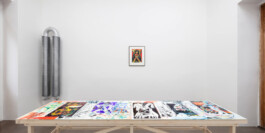
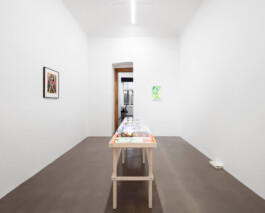
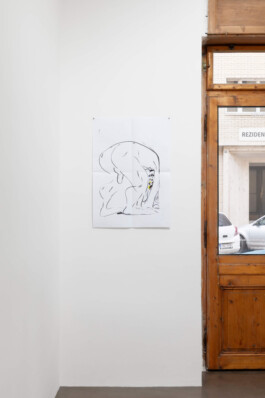
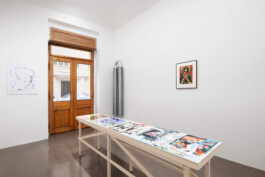
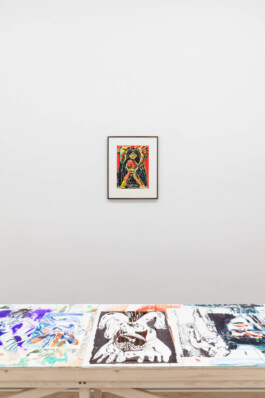
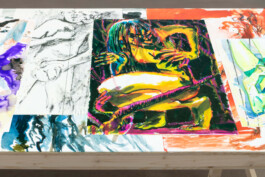
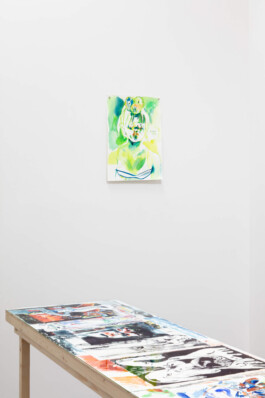
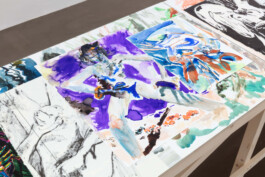
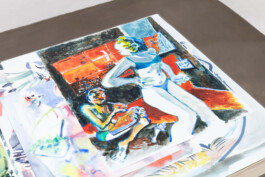
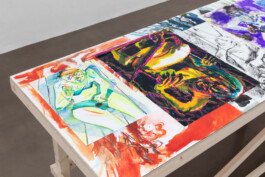
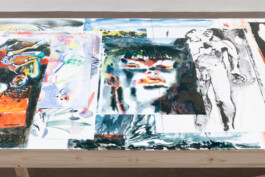
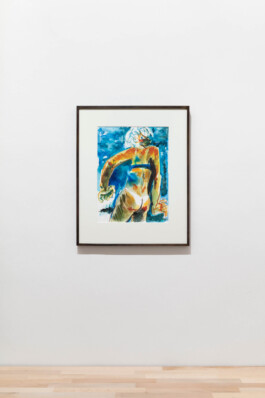
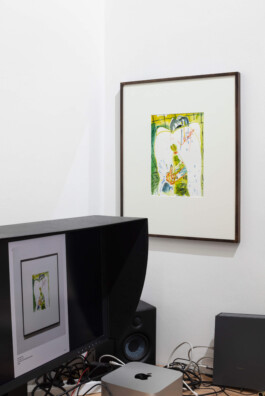
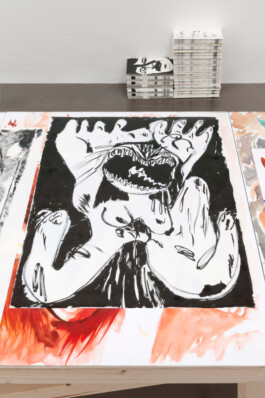
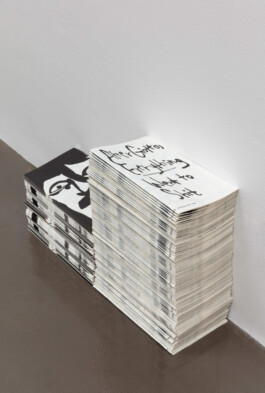
Martin Groch, They Are Ugly Because They Are Angry, photo Eva rybářová
Martin Groch, They Are Ugly Because They Are Angry, photo Eva rybářová
Martin Groch, They Are Ugly Because They Are Angry, photo Eva rybářová
Martin Groch, They Are Ugly Because They Are Angry, photo Eva rybářová
Martin Groch, They Are Ugly Because They Are Angry, photo Eva rybářová
Martin Groch, They Are Ugly Because They Are Angry, photo Eva rybářová
Martin Groch, They Are Ugly Because They Are Angry, photo Eva rybářová
Martin Groch, They Are Ugly Because They Are Angry, photo Eva rybářová
Martin Groch, They Are Ugly Because They Are Angry, photo Eva rybářová
Martin Groch, They Are Ugly Because They Are Angry, photo Eva rybářová
Martin Groch, They Are Ugly Because They Are Angry, photo Eva rybářová
Martin Groch, They Are Ugly Because They Are Angry, photo Eva rybářová
Martin Groch, They Are Ugly Because They Are Angry, photo Eva rybářová
Martin Groch, They Are Ugly Because They Are Angry, photo Eva rybářová
Martin Groch, They Are Ugly Because They Are Angry, photo Eva rybářová
Text by Persis Bekkering
Opening: December 18, 2025 / 6PM – 9PM
Dec 19, 2025 – Jan 31, 2026
Martin Groch — They Are Ugly Because They Are Angry
The gallery is pleased to present a solo exhibition by Slovak-born artist Martin Groch. Groch currently lives in Brussels and works as an artist, cartoonist, and graphic designer. The exhibition features new works on paper titled They Are Ugly Because They Are Angry.
As part of the exhibition, Clauda will host the launch of After Giotto, Everything Went to Shit, a new publication by Persis Bekkering and Martin Groch, to be published by Utopia Libri.
BIO:
Martin Groch (1990)
is an artist, illustrator and graphic designer currently based in Brussels. Throughout his diverse practices, he is interested in the narrative expression of images, desiring to find explosive visual forms on the edge of the readable. He prefers to situate himself in the tradition of drawing and cartooning, even where he uses paint and brush, and feels strongly drawn to the publication form and the reproduced image. He is the author of Sweathearts (Abyme 2024), a typeface and comic book, published by his dear friend, the late John Morgan.
Born in Košice (Slovakia), Groch has been professionally active as a graphic designer and artist at least since 2013. He first trained in graphic techniques and typography, at Umprum in Prague among other institutions, which he left precociously. From 2019 to 2020, he was a resident at the Jan van Eyck Post-Academy for Art, Design and Reflection in Maastricht. Among his frequent collaborators are Tim+Tim Studio, Jakub Samek, Robert Jansa, Peter Bosák, and Nana Esi (Atelier Brenda).
At the invitation of prof. Natasha M. Llorens (KKH Royal Institute of Art Stockholm) in 2020, he participated in a project titled Art-Rite, reinterpreting the iconic cheap art newspaper from 70s New York. At KKH, Groch was also invited to give workshops and lectures. He has since taught at the Royal Academy of Arts Antwerp, Ensad Nancy, and in the current season, at HfG Karlsruhe. Previous exhibitions of his work include the Jan van Eyck Academy Maastricht, PLATO Ostrava, the Salone del Mobile Milan.
Persis Bekkering (NL)
is a writer and critic, engaging with a wide spectrum of artistic disciplines. She is interested in forms of expression that account for the permanence of crisis in the contemporary world. She is the author of two novels in Dutch, A Hero’s Life (2018, shortlisted for the ANV Debut Prize) and Excess (2021, shortlisted for the BNG Bank Prize for Literature). Her novella Last Utopia is published in English translation by the Jan van Eyck Academy Maastricht. As a writer, performer, conversation partner and dramaturge, she collaborates with artists such as Martin Groch, Dora García and Benjamin Abel Meirhaeghe. She also teaches creative writing at ArtEZ University of the Arts in Arnhem (NL).
.....
“Why are you drawing women so ugly?” my father asked me when I was a teenager. Around the same time, my mother remarked that drawing like this makes me one of those old men — she must have meant those sleazy, sad, or bankrupt ones from the generation of my father or older. Alcoholics, failed poets, bad fathers were around then as they are now. Both my parents must have been suspicious of what would become of me. I don't know what I answered them. I draw them like I find them most interesting.
I have been taught it is not good art to draw a black outline, to draw eyelashes, and that good artist should hold back when depicting that glitter in someone’s eyes. It was the late modernist tradition with an eastern Czechoslovak-Hungarian flavor I grew up with. That is inevitably a matter of the place and class one is born into; that was my first inheritance. And then I discovered comics. Suddenly I was invested in the opposite of the moderate, restricted modern style of painting (that style that which evidently was never meant to be restricted, but that's how it appeared to me, at that point in my life). I asked my father, who was a publisher at the time, if I could ever make money by applying ink on paper in order to create images, and he said – yes, sure.
Now I mostly use black brushstrokes. I draw make-up, jewelry, and hair, sometimes more visibly than any facial features, and my references are the kind of images meant to be read - cartoons, gothic paintings on wooden panels, or those characters in the mid-19th-century work of Wilhelm Busch, Max and Moritz. I love Krazy Kat, I like Yuichi Yokoyama and his “New Engineering,” where comics get as loud as they possibly can. I like American underground comics, I like those dancing, breathing, confused and overwhelmed characters which one might find in comics from Belgium, France, the States, Japan. There is something about that mechanical line.
I draw people as types or as specific people. I draw characters. Women, men, animals. Sometimes I doubt whether a typological depiction of figures is lazy — as I was being told —, but then again, typology is also a way of seeing, a way of catching something shared between people. Typology is not only repetition; it is also the place where the hand is balancing between something automatic and something inventive, between what is programmed and what aims to be free. Because otherwise — what is the alternative?
There is much debate about where to draw the line between drawing and painting, but I like to call what I do ‘drawing'. The history of drawing speaks to me the most. It is the closest I have come to writing. I'm always trying to hit that edge of readability. I often buy and consume a catalogue or a book accompanying a show, and that is what causes me the most joy. That is how I relate myself to so-called fine art. The format of a catalogue, a book with a reduced image quality, it tears off the aura of the work. The work of an artist is thrown into the mundane circulation of everyday life. Exciting. Reproduction flattens the work. Finally it becomes a picture plane I can orient myself in. I also feel drawn to the writing that comes with it – essays, interviews, captions. I tend to enjoy any art in that mixed form, sometimes more than the exhibition itself.
I am from a country where cartoon, as a practice, does not have its own name, and as a discipline no terms to work with. Cartooning is not reflected upon, exists just in fragments. One might aspire to be “karikaturista”, which means to do caricature, or to do “kreslený vtip”, which means to draw jokes. And who wants to be that? Yet there is something so captivating in how the pen in interaction with a sheet of paper is able to do anything within a very limited space, to depict scenes of any kind, to build mise-en-scènes. I’m sometimes telling myself this is the closest I can get to writing. To do cartoons is to count with the reader, to be read. I draw a head and it is a circle with eyes, that circle is a line and eyes are dots; I like to think “how is it possible we can read that abstract form?”
“One good reproduction is worth a thousand poor originals.” My works are rather small in format, and there is a reason for that. I want to have them scanned at the best possible quality I can achieve, in order to be able to put them to work, to make a reproduction. Standing side by side with the scanner has become something that takes up a significant part of my working time. If one looks at comics originals — American, French, Japanese, the older ones that belong to history — there is, for many, a charming mess created by functional marks: pure cyan pencil underneath the black drawing, marks left for printers and editors, notes on coloring or cropping the image. There is always the consideration of scale involved, of how much one can or should reduce a drawing to have the right impact within the chosen format. With reproduction one is losing something but there is a good and fair exchange: work that is reproduced is meant to be engaged with differently than the original; it is meant to be consumed with appetite, it is not precious. Reproduction, much like a book without a spine, has no authority.
When I made the works for “They Are Ugly Because They Are Angry,” I was not thinking about the possibility of an exhibition at all; I thought I would show them in a magazine or in some printed form or another. And so this work was always pleasurable to do, without pressure. I have an immense interest in the structural and emotional meaning of them. I happily accept it if they stay on the margin.
I have strange ambitions. I wish to be like Tove Jansson — a failed painter who was at her best making cartoons, illustrations and children’s books. I wish to have something of Carol Rama, who was fearless in drawing phalluses and unsettling women — things you don’t want to see but cannot look away from. It doesn’t feel comfortable, and it hits with the kind of impact I admire. And something of the Hernandez Brothers and their Love and Rockets series: where the characters – women – are as much typologies, shaped by a learned way of drawing, as they are alive. And body parts, in all kinds of forms, are everywhere — and they don’t mean “sex”, but even so. They’re juicy as hell. They might be angry. Not ugly at all.
Martin Groch, edited by Persis Bekkering
Martin Groch, They Are Ugly Because They Are Angry, photo Eva rybářová
Martin Groch, They Are Ugly Because They Are Angry, photo Eva rybářová
Martin Groch, They Are Ugly Because They Are Angry, photo Eva rybářová
Martin Groch, They Are Ugly Because They Are Angry, photo Eva rybářová
Martin Groch, They Are Ugly Because They Are Angry, photo Eva rybářová
Martin Groch, They Are Ugly Because They Are Angry, photo Eva rybářová
Martin Groch, They Are Ugly Because They Are Angry, photo Eva rybářová
Martin Groch, They Are Ugly Because They Are Angry, photo Eva rybářová
Martin Groch, They Are Ugly Because They Are Angry, photo Eva rybářová
Martin Groch, They Are Ugly Because They Are Angry, photo Eva rybářová
Martin Groch, They Are Ugly Because They Are Angry, photo Eva rybářová
Martin Groch, They Are Ugly Because They Are Angry, photo Eva rybářová
Martin Groch, They Are Ugly Because They Are Angry, photo Eva rybářová
Martin Groch, They Are Ugly Because They Are Angry, photo Eva rybářová
Martin Groch, They Are Ugly Because They Are Angry, photo Eva rybářová
Text by Adéla Janíčková
Opening: November 5, 2025 / 6PM – 9PM
Nov 6 – Dec 12, 2025
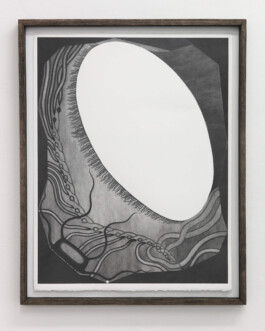
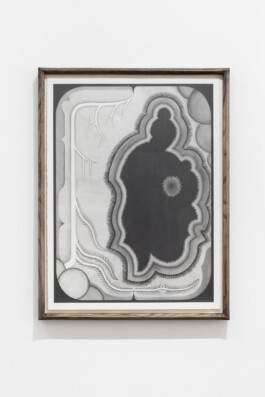
Lashes, 51 X 66 CM, GRAPHITE ON PAPER, 2023, PHOTO AUTHOR'S ARCHIVE
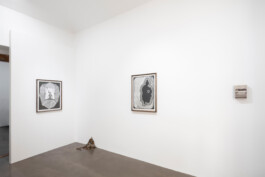
We cordially invite you to the exhibition of Julie Daňhelová's exhibition Unearth Me.
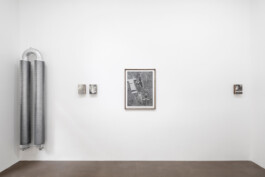
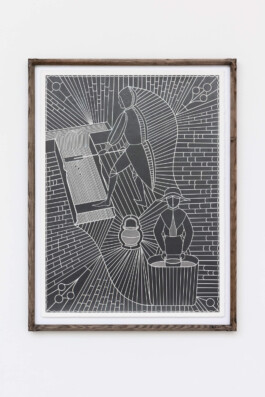
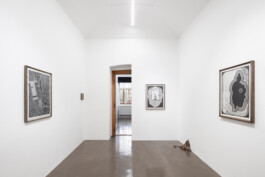
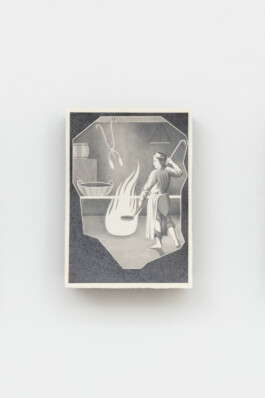
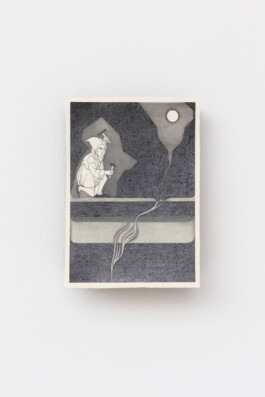
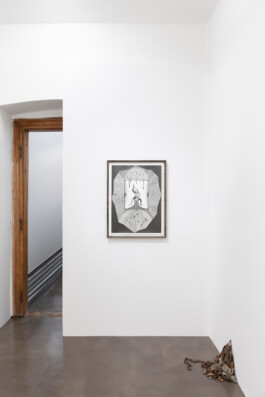
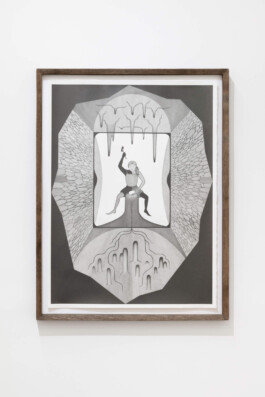
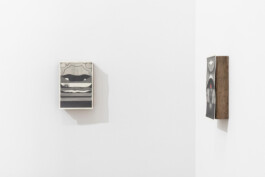
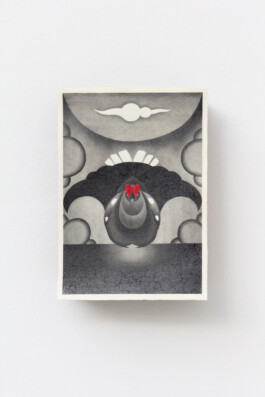
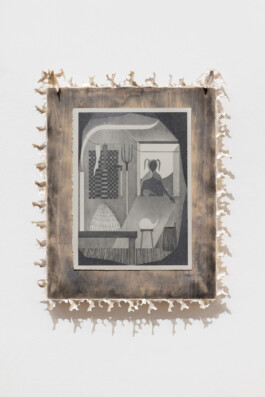
The black-and-white drawings of Julie Daňhelová balance between historical document and fantastical imagination. Her works are mounted in custom-made frames, often adorned with original carvings. Her art practice extends beyond paper to include in-situ installations – objects that evoke alchemical experiments and silent rituals.
Drawn with delicate graphite pencil on handmade paper, Daňhelová’s works fascinate with their perfection. Although the elaborate execution may appear as a result of meticulous preparation, their precision and rhythm emerge from an intense focus – from a meditative state of mind in which thought, hand, and paper become one. The drawing itself leads the process. What unfolds are mysterious environments filled with intricate details and encoded meanings. The scenes may resemble hermetic images, conveying deep wisdom. The artist’s work with paper reinforces this transmission of knowledge; though fragile, paper has served since ancient times as a tool of civilizations to leave their imprint on history.
From the Ore Mountains come stories of how people once subdued the landscape, and at the same time how the landscape quietly shapes human lives. Starting in the sixteenth century, the Ore Mountains experienced a mining fever. People from all over Europe – Venetians, Saxons, Czechs – came to the region, united by the vision of gaining wealth from the metal in the earth’s depths. Everything born here has been repeatedly extracted, plundered, and rediscovered. The burdensome history of the Sudetenland transforms in the artist’s drawings into a poetry of fateful cycles, an endless excavation of the memory of people and places.
During this period, a gentler Ore Mountains tradition came into being – bobbin lace. The entrepreneur, philanthropist, and pioneer of Ore Mountain lace-making, Barbara Uthmann from Annaberg, provided work for hundreds of women and later also for the male miners themselves, who in the evenings, when winter closed the mines, spun threads instead of ore to earn extra income. The contrast between the hard labor in the depths and the delicate movement of hands creating webs of thread is essential for Julie Daňhelová: two sides of the same coin, two ways in which a person transforms matter – and themselves.
Fragments of the past appear on the frames themselves, decorated with chipped pieces of mother-of-pearl. It was from these shells that ornamental buttons used to be made in Kraslice, where Julie has been spending her time since childhood. The leftovers from home production ended up scattered throughout the landscape. Julie finds the discarded material and incorporates it into her works as a memento of what once connected people to their land. The cassetta frames, forming a whole with the drawings, are created in collaboration with Kryštof Kučera and become original artefacts – another layer in the story of transformation and continuity.
Her work with materials evokes an alchemical process – the transmutation of found fragments into new forms that carry both awareness and purification. Mining becomes a metaphor for uncovering layers and transformation – the reshaping of matter as well as of the past. Here, art becomes a process of sublimation through which the artist regenerates the soil and the soul of both place and people. The ghosts of the Ore Mountains are not shadows of the past but a living presence around and within us, with whom Julie engages in a silent dialogue. The exhibition title Unearth me symbolically calls for rediscovery and understanding.
The land is both an archive and a warning. In a time when the prospect of lithium mining is once again discussed, her work serves as a reminder that the earth is not an inexhaustible resource, but a living body to which we are bound by responsibility and memory.
Adéla Janíčková
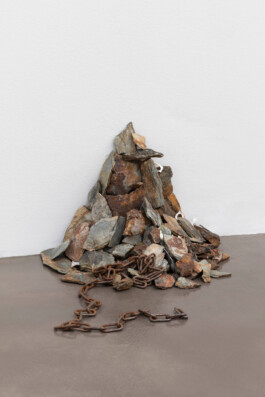
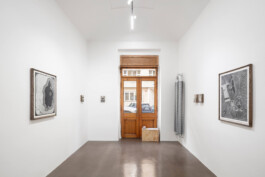
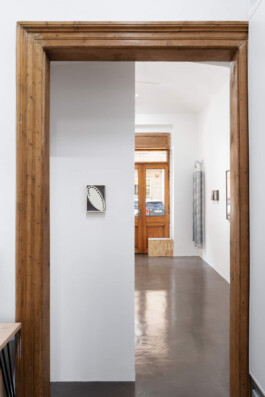
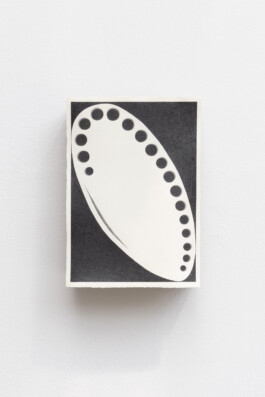
Text by Adéla Janíčková
Opening: November 5, 2025 / 6PM – 9PM
Nov 6 – Dec 12, 2025
Lashes, 51 X 66 CM, GRAPHITE ON PAPER, 2023, PHOTO AUTHOR'S ARCHIVE
We cordially invite you to the exhibition of Julie Daňhelová's exhibition Unearth Me.
The black-and-white drawings of Julie Daňhelová balance between historical document and fantastical imagination. Her works are mounted in custom-made frames, often adorned with original carvings. Her art practice extends beyond paper to include in-situ installations – objects that evoke alchemical experiments and silent rituals.
Drawn with delicate graphite pencil on handmade paper, Daňhelová’s works fascinate with their perfection. Although the elaborate execution may appear as a result of meticulous preparation, their precision and rhythm emerge from an intense focus – from a meditative state of mind in which thought, hand, and paper become one. The drawing itself leads the process. What unfolds are mysterious environments filled with intricate details and encoded meanings. The scenes may resemble hermetic images, conveying deep wisdom. The artist’s work with paper reinforces this transmission of knowledge; though fragile, paper has served since ancient times as a tool of civilizations to leave their imprint on history.
From the Ore Mountains come stories of how people once subdued the landscape, and at the same time how the landscape quietly shapes human lives. Starting in the sixteenth century, the Ore Mountains experienced a mining fever. People from all over Europe – Venetians, Saxons, Czechs – came to the region, united by the vision of gaining wealth from the metal in the earth’s depths. Everything born here has been repeatedly extracted, plundered, and rediscovered. The burdensome history of the Sudetenland transforms in the artist’s drawings into a poetry of fateful cycles, an endless excavation of the memory of people and places.
During this period, a gentler Ore Mountains tradition came into being – bobbin lace. The entrepreneur, philanthropist, and pioneer of Ore Mountain lace-making, Barbara Uthmann from Annaberg, provided work for hundreds of women and later also for the male miners themselves, who in the evenings, when winter closed the mines, spun threads instead of ore to earn extra income. The contrast between the hard labor in the depths and the delicate movement of hands creating webs of thread is essential for Julie Daňhelová: two sides of the same coin, two ways in which a person transforms matter – and themselves.
Fragments of the past appear on the frames themselves, decorated with chipped pieces of mother-of-pearl. It was from these shells that ornamental buttons used to be made in Kraslice, where Julie has been spending her time since childhood. The leftovers from home production ended up scattered throughout the landscape. Julie finds the discarded material and incorporates it into her works as a memento of what once connected people to their land. The cassetta frames, forming a whole with the drawings, are created in collaboration with Kryštof Kučera and become original artefacts – another layer in the story of transformation and continuity.
Her work with materials evokes an alchemical process – the transmutation of found fragments into new forms that carry both awareness and purification. Mining becomes a metaphor for uncovering layers and transformation – the reshaping of matter as well as of the past. Here, art becomes a process of sublimation through which the artist regenerates the soil and the soul of both place and people. The ghosts of the Ore Mountains are not shadows of the past but a living presence around and within us, with whom Julie engages in a silent dialogue. The exhibition title Unearth me symbolically calls for rediscovery and understanding.
The land is both an archive and a warning. In a time when the prospect of lithium mining is once again discussed, her work serves as a reminder that the earth is not an inexhaustible resource, but a living body to which we are bound by responsibility and memory.
Adéla Janíčková
Text by Eva Slabá
Opening: Sep 11 / 6 pm – 9 pm
Sep 12 – Oct 25 2025
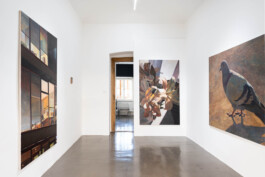
VASIL ARTAMONOV, MONSTERA, INSTALLATION VIEW, 2025, PHOTO LUKÁŠ HAVLENA
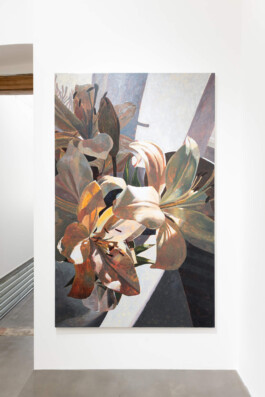
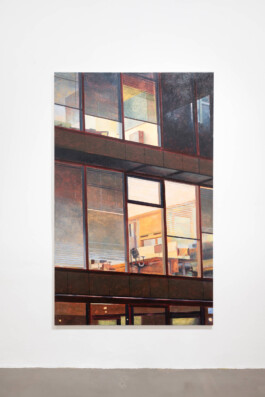
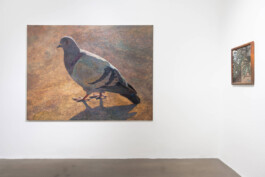
Vasil Artamonov’s latest series of paintings depicts scenes from everyday urban life: a glimpse into an office building, a still life with lilies, a portrait of a pigeon. The very title of the exhibition suggests that these are banal motifs, but their simplicity conceals deeper layers of unease. A typical example is the monstera—nowadays it is a neutral houseplant decorating corporate open spaces, the hallways of apartment buildings, and various waiting rooms, but not so long ago it was perceived as a strangely shaped and slightly frightening “monster.” Artamonov plucks it from its decorative context and uses it as a metaphorical tool to highlight the latent tension hidden beneath the surface of normality, as he also did, for example, with the motif of the collection and processing of personal data, which he dealt with in previous cycles. His canvases thus featured data storage towers, omniscient birds, and schematics for monitoring devices resembling ahistorical symbols. In this exhibition, Artamonov has opted for a line of inquiry that, while similar in content, is different and more straightforward.
The canvas with a larger-than-life pigeon builds on the aforementioned contemplation of the intertwining of different planes of contemporary cosmopolitan experience. Cornelia Sollfrank and Felix Stalder also clearly highlight this entanglement in their book Contemporaneity in Embodied Data Practices (2025), where, in addition to describing individual, natural, and historical-cultural levels, they also identify a technological-data plane. The authors illustrate this idea using a study on the rewilding of migratory birds: The birds are tagged with tracking devices, and, thanks to the data they collect, the animals can then be released back into the wild without further human intervention. This creates a new type of relationship between the living, the non-living, and the technological, which under certain conditions can take on symbiotic qualities. The opposite mechanism can be observed in pigeons: While in ancient times they were valued as tireless messengers with the exceptional ability to navigate across hundreds of kilometers, with the development of technology they were gradually reclassified as unwanted urban pests. Next to disused balconies covered in bird droppings and hallway corners decorated with monsteras, we see coffee tables with vases of lilies, which have been analogously pushed aside. Their pungent scent, richly colored pollen, and potential toxicity have transformed these once-revered flowers, which have strong spiritual symbolism, into outdated gifts that do not fit into the sterile framework of contemporary professionalism.
Alongside the bird and plant motifs, we can ultimately trace this connection in the image of an office building. In the scope of residency programs, artists are increasingly entering into corporate environments in the role of consultants who are expected to provide a critical and humanizing perspective. In this context, we can recall Elvia Wilk’s novel Oval (2019), in which an artist develops a pill that temporarily makes users more empathetic and generous. However, the novel’s dystopian conclusion suggests that real change takes time and patience and cannot be replaced by a technological shortcut, contrasting sharply with the logic of the corporate world, which prioritizes efficient, optimized, and measurable results over a long-term process of transformation.
Although Artamonov’s paintings deal with complex themes, they use everyday motifs to raise critical questions about the nature of contemporary life. They are not merely imitations of life but rather a modulated exploration of it—they expose hidden structures and mechanisms in both explicit and silent threats, while also acting as indicators of our adaptive responses. If our present is a situation in which we have arrived on time for a meeting that we are doomed to miss, as Giorgio Agamben characterizes it, then Artamonov’s Monstera can be understood as an attempt to at least momentarily manifest and render this paradoxical feeling through painting.
Eva Slabá
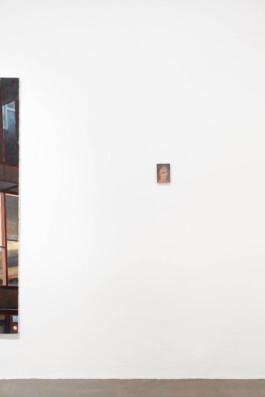
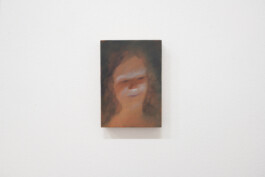
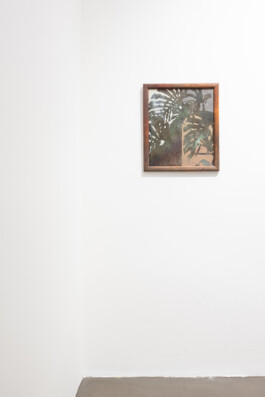
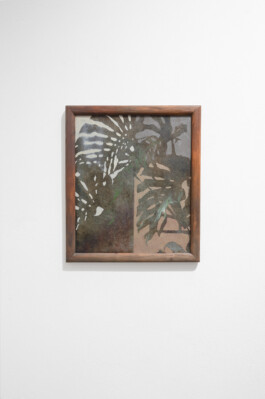
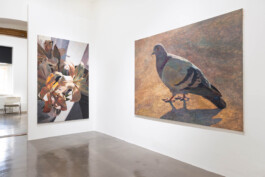
VASIL ARTAMONOV, MONSTERA, INSTALLATION VIEW, 2025, PHOTO LUKÁŠ HAVLENA
VASIL ARTAMONOV, LILIES, 125 X 200 CM, OIL ON CANVAS, INSTALLATION VIEW, 2025, PHOTO LUKÁŠ HAVLENA
VASIL ARTAMONOV, OFFICE BUILDING, 125 X 200 CM, OIL ON CANVAS, INSTALLATION VIEW, 2025
VASIL ARTAMONOV, MONSTERA, NSTALLATION VIEW, 2025, PHOTO LUKÁŠ HAVLENA
VASIL ARTAMONOV, HEAD, 10,5 X 15 CM, OIL ON PLYWOOD, INSTALLATION VIEW, 2025, PHOTO LUKÁŠ HAVLENA
VASIL ARTAMONOV, MONSTERA, 43,5 X 50,5 CM, OIL ON CHIPBOARD, INSTALLATION VIEW, 2025, PHOTO LUKÁŠ HAVLENA
VASIL ARTAMONOV, MONSTERA, 43,5 X 50,5 CM, OIL ON CHIPBOARD, INSTALLATION VIEW, 2025, PHOTO LUKÁŠ HAVLENA
VASIL ARTAMONOV, PIGEON, 200 X 150 CM, OIL ON CANVAS, INSTALLATION VIEW, 2025, PHOTO LUKÁŠ HAVLENA
VASIL ARTAMONOV, MONSTERA, INSTALLATION VIEW, 2025, PHOTO LUKÁŠ HAVLENA
Text by Eva Slabá
Opening: Sep 11 / 6 pm – 9 pm
Sep 12 – Oct 25 2025
VASIL ARTAMONOV, MONSTERA, INSTALLATION VIEW, 2025, PHOTO LUKÁŠ HAVLENA
Vasil Artamonov’s latest series of paintings depicts scenes from everyday urban life: a glimpse into an office building, a still life with lilies, a portrait of a pigeon. The very title of the exhibition suggests that these are banal motifs, but their simplicity conceals deeper layers of unease. A typical example is the monstera—nowadays it is a neutral houseplant decorating corporate open spaces, the hallways of apartment buildings, and various waiting rooms, but not so long ago it was perceived as a strangely shaped and slightly frightening “monster.” Artamonov plucks it from its decorative context and uses it as a metaphorical tool to highlight the latent tension hidden beneath the surface of normality, as he also did, for example, with the motif of the collection and processing of personal data, which he dealt with in previous cycles. His canvases thus featured data storage towers, omniscient birds, and schematics for monitoring devices resembling ahistorical symbols. In this exhibition, Artamonov has opted for a line of inquiry that, while similar in content, is different and more straightforward.
The canvas with a larger-than-life pigeon builds on the aforementioned contemplation of the intertwining of different planes of contemporary cosmopolitan experience. Cornelia Sollfrank and Felix Stalder also clearly highlight this entanglement in their book Contemporaneity in Embodied Data Practices (2025), where, in addition to describing individual, natural, and historical-cultural levels, they also identify a technological-data plane. The authors illustrate this idea using a study on the rewilding of migratory birds: The birds are tagged with tracking devices, and, thanks to the data they collect, the animals can then be released back into the wild without further human intervention. This creates a new type of relationship between the living, the non-living, and the technological, which under certain conditions can take on symbiotic qualities. The opposite mechanism can be observed in pigeons: While in ancient times they were valued as tireless messengers with the exceptional ability to navigate across hundreds of kilometers, with the development of technology they were gradually reclassified as unwanted urban pests. Next to disused balconies covered in bird droppings and hallway corners decorated with monsteras, we see coffee tables with vases of lilies, which have been analogously pushed aside. Their pungent scent, richly colored pollen, and potential toxicity have transformed these once-revered flowers, which have strong spiritual symbolism, into outdated gifts that do not fit into the sterile framework of contemporary professionalism.
Alongside the bird and plant motifs, we can ultimately trace this connection in the image of an office building. In the scope of residency programs, artists are increasingly entering into corporate environments in the role of consultants who are expected to provide a critical and humanizing perspective. In this context, we can recall Elvia Wilk’s novel Oval (2019), in which an artist develops a pill that temporarily makes users more empathetic and generous. However, the novel’s dystopian conclusion suggests that real change takes time and patience and cannot be replaced by a technological shortcut, contrasting sharply with the logic of the corporate world, which prioritizes efficient, optimized, and measurable results over a long-term process of transformation.
Although Artamonov’s paintings deal with complex themes, they use everyday motifs to raise critical questions about the nature of contemporary life. They are not merely imitations of life but rather a modulated exploration of it—they expose hidden structures and mechanisms in both explicit and silent threats, while also acting as indicators of our adaptive responses. If our present is a situation in which we have arrived on time for a meeting that we are doomed to miss, as Giorgio Agamben characterizes it, then Artamonov’s Monstera can be understood as an attempt to at least momentarily manifest and render this paradoxical feeling through painting.
Eva Slabá
VASIL ARTAMONOV, MONSTERA, INSTALLATION VIEW, 2025, PHOTO LUKÁŠ HAVLENA
VASIL ARTAMONOV, LILIES, 125 X 200 CM, OIL ON CANVAS, INSTALLATION VIEW, 2025, PHOTO LUKÁŠ HAVLENA
VASIL ARTAMONOV, OFFICE BUILDING, 125 X 200 CM, OIL ON CANVAS, INSTALLATION VIEW, 2025
VASIL ARTAMONOV, MONSTERA, NSTALLATION VIEW, 2025, PHOTO LUKÁŠ HAVLENA
VASIL ARTAMONOV, HEAD, 10,5 X 15 CM, OIL ON PLYWOOD, INSTALLATION VIEW, 2025, PHOTO LUKÁŠ HAVLENA
VASIL ARTAMONOV, MONSTERA, 43,5 X 50,5 CM, OIL ON CHIPBOARD, INSTALLATION VIEW, 2025, PHOTO LUKÁŠ HAVLENA
VASIL ARTAMONOV, MONSTERA, 43,5 X 50,5 CM, OIL ON CHIPBOARD, INSTALLATION VIEW, 2025, PHOTO LUKÁŠ HAVLENA
VASIL ARTAMONOV, PIGEON, 200 X 150 CM, OIL ON CANVAS, INSTALLATION VIEW, 2025, PHOTO LUKÁŠ HAVLENA
VASIL ARTAMONOV, MONSTERA, INSTALLATION VIEW, 2025, PHOTO LUKÁŠ HAVLENA
VIP Opening Friday Sep 05
Sat – Sun 06-07 Sep
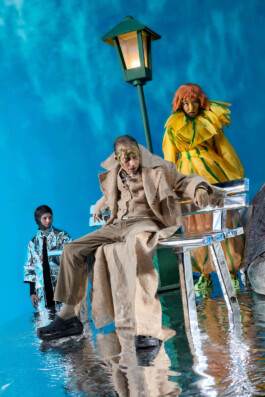
Photo Michal Ureš
Join us for the 4th edition of the Hotel Warszawa Art Fair, a contemporary art event hosted on the first and second floors of Hotel Warszawa, an architectural icon of pre-war Warsaw and a symbol of the city.
Hotel Warszawa Art Fair is Poland’s first contemporary art fair to be hosted on the premises of a hotel. The event has been brought to life thanks to a collaboration between the gallerists Gunia Nowik from Gunia Nowik Gallery, Marta Kołakowska from LETO, Justyna Wesołowska and Marika Zamojska from Polana Institute, and the Likus Hotel and Restaurant Group. It aims to inscribe itself in the history of international art fairs hosted in hotels, such as the Gramercy International Art Fair at the Gramercy Hotel in New York, or the Felix Art Fair at the Hollywood Roosevelt Hotel in Los Angeles.
Artists:
Vasil artamonov
Julie Daňhelová
Tomáš Roubal
Jakub Jansa
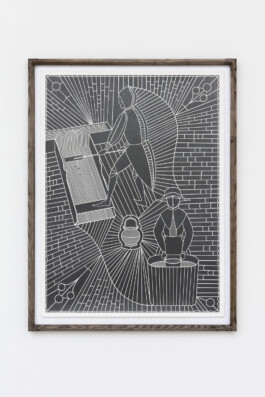
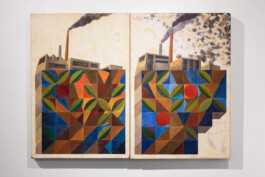
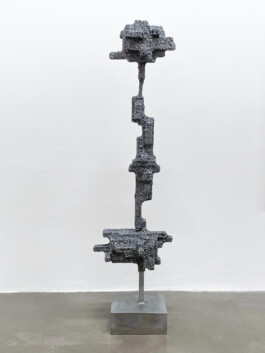
Julie Danhelova, Tin_Ore_Panning, 2025
Jakub Jansa, PUMPKINVILLE, A SHORT FILM (15MINS, 4K), 2024
Vasil Artamonov, THE BASE AND SUPERSTRUCTURE, 103 X 71 CM (2×), OIL AND MIXED MEDIA ON FIBREBOARD, DIPTYCH, 2023
Tomáš Roubal, Untitled, 150 x 60 x 50 cm, steel, 2024
VIP Opening Friday Sep 05
Sat – Sun 06-07 Sep
Photo Michal Ureš
Join us for the 4th edition of the Hotel Warszawa Art Fair, a contemporary art event hosted on the first and second floors of Hotel Warszawa, an architectural icon of pre-war Warsaw and a symbol of the city.
Hotel Warszawa Art Fair is Poland’s first contemporary art fair to be hosted on the premises of a hotel. The event has been brought to life thanks to a collaboration between the gallerists Gunia Nowik from Gunia Nowik Gallery, Marta Kołakowska from LETO, Justyna Wesołowska and Marika Zamojska from Polana Institute, and the Likus Hotel and Restaurant Group. It aims to inscribe itself in the history of international art fairs hosted in hotels, such as the Gramercy International Art Fair at the Gramercy Hotel in New York, or the Felix Art Fair at the Hollywood Roosevelt Hotel in Los Angeles.
Artists:
Vasil artamonov
Julie Daňhelová
Tomáš Roubal
Jakub Jansa
Julie Danhelova, Tin_Ore_Panning, 2025
Jakub Jansa, PUMPKINVILLE, A SHORT FILM (15MINS, 4K), 2024
Vasil Artamonov, THE BASE AND SUPERSTRUCTURE, 103 X 71 CM (2×), OIL AND MIXED MEDIA ON FIBREBOARD, DIPTYCH, 2023
Tomáš Roubal, Untitled, 150 x 60 x 50 cm, steel, 2024
Curator Andrew Wilson
Opening Jun 4 / 6 pm – 9 pm
June 5 – 27 2025
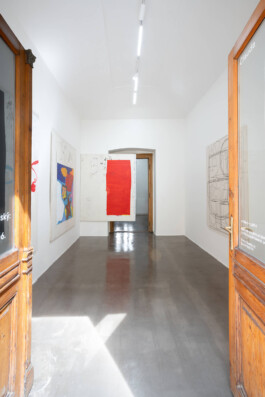
At the beginning of the last century there came a sudden shift in perspective, wherein the fixed form of a human subject receded and dissipated into a swarm of abstracted, quantifiable movements. Form became an index of time and motion to be traced, compressed, standardized, and made efficient. This aesthetic turn was, perhaps more noticeably than any before, anchored in an economic and industrial transformation, more an effect (and contributing factor) of Taylorism than a purely art-historical innovation or recapitulation. Likewise, the aesthetic tendencies organized around this abstraction of motion – the geometry of movement in Marey and Muybridge’s photography, the use of chronocyclegraphs and photodynamism in motion studies, the “new vision” of constructivism – scaled individual and collective life down to a tangle of lines, arcs and spirals.
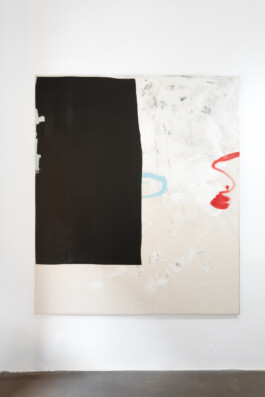
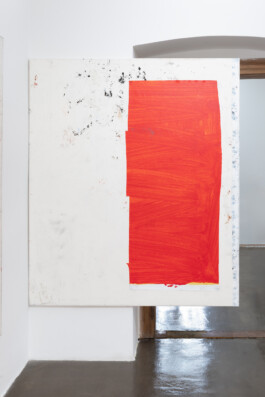
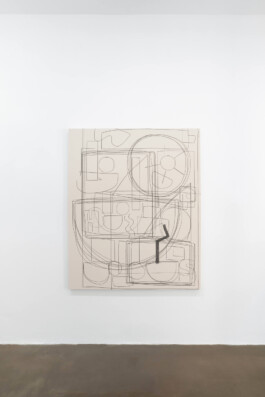
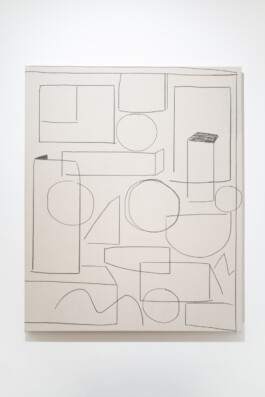
While our present world may seem detached from these seemingly elemental preoccupations, the geometric abstraction of time and motion is more pervasive than ever. However, unlike the brash, radiant lines of photodynamism, we are greeted with a “frictionless” vision of the world where the constant abstraction and control of movement blends into the environment of everyday life, quietly operating within platforms and algorithms. David Krňanský’s new series of works draws this reality into sharp relief, attuning us to a kinesthetic scale of looping, recursive gestures, of forking and converging paths. Yet despite this excess of motion, we are confronted with a grim fixity as these forms repeat across the surface of the canvas, blackening into borders: a fragile, snaking line is swept into an arc and crosses back over itself, becoming locked into its own iterative pattern; another slips around curves and edges until its trajectory is suddenly cut off – trapped, no exit between the shapes closing in from every side…
Abstraction: bodies become motion, motion becomes lines, lines become cells, cells become bodies.
Novelist and filmmaker Alain Robbe-Grillet once wrote of the “generative cell,” a logic of entrapment and enclosure reproducing itself across scales, generating the architectonics of a polis like a cell generates a body. It is in this sense that we may conceive of the twofold cellularity identified by Krňanský’s motifs and their relation to past constructivisms. Just as the old Taylorism was ordered around the production of the physical commodity, the abstract form of the commodity functioned as the “cell” of a wider mode of production (one that has long outlasted the factory floors of Philadelphia). In today’s world, as our individual and collective movement itself is increasingly abstracted, controlled, and commodified, it becomes doubly “cellular:” reproducing a contemporary situation in which motion becomes its own form of incarceration. Yet Krňanský’s motifs also open onto a world in which such geometries, generatively, fail: the repeating lines never quite “line up,” rendering new voids and infinite in-between spaces, promising rupture or even total collapse. Further, the canvases of past, “failed” works are cut up and reconfigured into new shapes, leaving us with a curious sense that failed geometries, like broken cells, might just provide the rudiments of a new, im/possible body.
Andrew Wilson
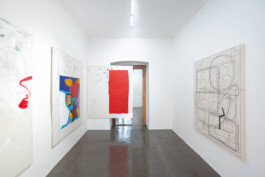
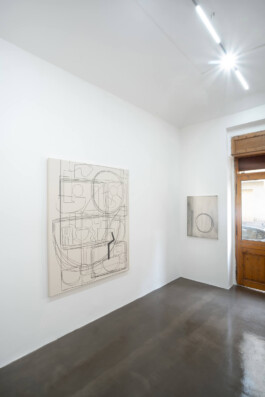
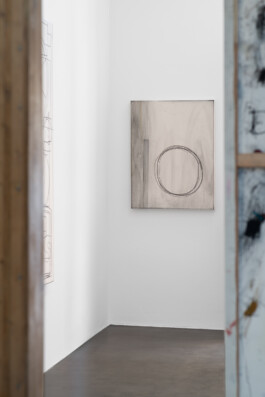
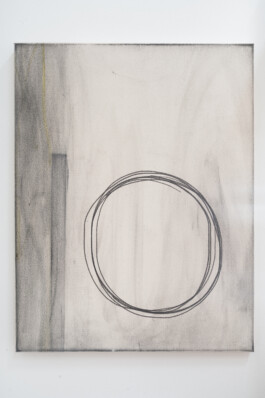
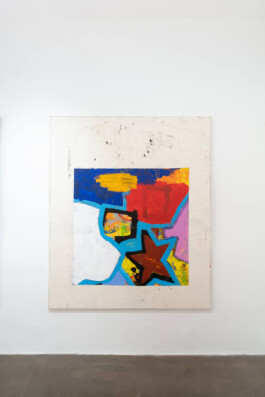
David KrŇanskÝ, Cell, photo Michal UreŠ
David KrŇanskÝ, Cell, photo Michal UreŠ
David KrŇanskÝ, Cell, photo Michal UreŠ
David KrŇanskÝ, Cell, photo Michal UreŠ
David KrŇanskÝ, Cell, photo Michal UreŠ
David KrŇanskÝ, Cell, photo Michal UreŠ
David KrŇanskÝ, Cell, photo Michal UreŠ
David KrŇanskÝ, Cell, photo Michal UreŠ
David KrŇanskÝ, Cell, photo Michal UreŠ
Curator Andrew Wilson
Opening Jun 4 / 6 pm – 9 pm
June 5 – 27 2025
At the beginning of the last century there came a sudden shift in perspective, wherein the fixed form of a human subject receded and dissipated into a swarm of abstracted, quantifiable movements. Form became an index of time and motion to be traced, compressed, standardized, and made efficient. This aesthetic turn was, perhaps more noticeably than any before, anchored in an economic and industrial transformation, more an effect (and contributing factor) of Taylorism than a purely art-historical innovation or recapitulation. Likewise, the aesthetic tendencies organized around this abstraction of motion – the geometry of movement in Marey and Muybridge’s photography, the use of chronocyclegraphs and photodynamism in motion studies, the “new vision” of constructivism – scaled individual and collective life down to a tangle of lines, arcs and spirals.
While our present world may seem detached from these seemingly elemental preoccupations, the geometric abstraction of time and motion is more pervasive than ever. However, unlike the brash, radiant lines of photodynamism, we are greeted with a “frictionless” vision of the world where the constant abstraction and control of movement blends into the environment of everyday life, quietly operating within platforms and algorithms. David Krňanský’s new series of works draws this reality into sharp relief, attuning us to a kinesthetic scale of looping, recursive gestures, of forking and converging paths. Yet despite this excess of motion, we are confronted with a grim fixity as these forms repeat across the surface of the canvas, blackening into borders: a fragile, snaking line is swept into an arc and crosses back over itself, becoming locked into its own iterative pattern; another slips around curves and edges until its trajectory is suddenly cut off – trapped, no exit between the shapes closing in from every side…
Abstraction: bodies become motion, motion becomes lines, lines become cells, cells become bodies.
Novelist and filmmaker Alain Robbe-Grillet once wrote of the “generative cell,” a logic of entrapment and enclosure reproducing itself across scales, generating the architectonics of a polis like a cell generates a body. It is in this sense that we may conceive of the twofold cellularity identified by Krňanský’s motifs and their relation to past constructivisms. Just as the old Taylorism was ordered around the production of the physical commodity, the abstract form of the commodity functioned as the “cell” of a wider mode of production (one that has long outlasted the factory floors of Philadelphia). In today’s world, as our individual and collective movement itself is increasingly abstracted, controlled, and commodified, it becomes doubly “cellular:” reproducing a contemporary situation in which motion becomes its own form of incarceration. Yet Krňanský’s motifs also open onto a world in which such geometries, generatively, fail: the repeating lines never quite “line up,” rendering new voids and infinite in-between spaces, promising rupture or even total collapse. Further, the canvases of past, “failed” works are cut up and reconfigured into new shapes, leaving us with a curious sense that failed geometries, like broken cells, might just provide the rudiments of a new, im/possible body.
Andrew Wilson
David KrŇanskÝ, Cell, photo Michal UreŠ
David KrŇanskÝ, Cell, photo Michal UreŠ
David KrŇanskÝ, Cell, photo Michal UreŠ
David KrŇanskÝ, Cell, photo Michal UreŠ
David KrŇanskÝ, Cell, photo Michal UreŠ
David KrŇanskÝ, Cell, photo Michal UreŠ
David KrŇanskÝ, Cell, photo Michal UreŠ
David KrŇanskÝ, Cell, photo Michal UreŠ
David KrŇanskÝ, Cell, photo Michal UreŠ
Květen 22–25 2025
artists: Valentýna Janů, Matyáš Maláč
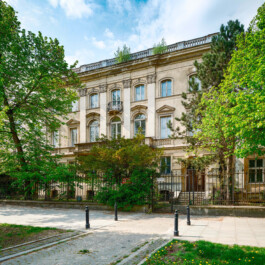
V sérii Dots působí dílo Valentýny Janů současně svůdně i znepokojivě. Vtahuje diváka do puntíkované topologie, kde se záplaty na povrchu náhle uvolňují ze stehů a kloužou sem a tam – nejprve konvexní, poté konkávní, až se proměňují v otvory, průduchy připomínající kleiniánské portály, které převracejí vnitřek ven a vnějšek dovnitř. Je to smyslná topologie: puntík obepíná vlastní geometrii, stává se koulí a jeho měkká tkanina jemně odhaluje to, co zároveň zakrývá. Kruhy získávají další rozměr a spouští žebřík k portálu, jenž přenáší diváka dovnitř – a zároveň ven, zpět k vlastnímu tělu.
Práce Matyáše Maláče se stáčí do vlastní, šlachovité topologie. Vtahuje – méně jemně, avšak vždy hravě – do žhnoucího, synestetického světa. Úlomky internetových obrazů prorážejí záhyby psyché a obracejí ji naruby, do světa hemžícího se svéhlavými entitami. Smyslové se tu rozpadá ve jménu hyper-smyslovosti, vtělené do slov, která se zbavují významu, a přesto působí ještě těžší svou signifikancí – jako znamení doby. Vzniká paranoidní topologie, v níž otvor je otvorem, ale zároveň i něčím víc… ústy, která v sobě nesou celé světy.
Valentýna Janů (1994) je umělkyně pracující v Praze, která po studiu fotografie na FAMU pokračovala v ateliéru Intermédia II na Akademii výtvarných umění v Praze (Dušan Zahoranský, Pavla Sceranková). Ve své tvorbě využívá objekty, textilie, vzory a hru jednobarevných ploch k vytváření spekulativních prostředí, jež nenápadně vedou diváky k otázkám o propojení sexuality, ekologie a výrobních procesů. V roce 2021 získala prestižní Cenu Jindřicha Chalupeckého a v posledních letech vystavovala v Praze, Vídni, Budapešti a dalších evropských městech.
Matyáš Maláč je absolventem Akademie výtvarných umění v Praze (2023), kde studoval v ateliéru Malba II u Vladimíra Skrepla. Jeho tvorba je bohatá co do objemu i záběru; těžištěm je malba, avšak zasahuje do celé řady médií. Inspirován širokým spektrem umělců i teoretiků zkoumá postavení umění po post-internetové éře a pohybuje se na pomezí post-internetové a novoromantické tendence. Jeho kompozice jsou formálně expanzivní a spojují různé styly i techniky. V posledních letech vystavoval v Praze, Vídni, New Yorku, Athénách, Istanbulu a na dalších místech.
Text: Andrew Wilson
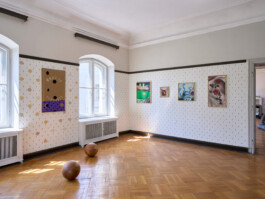
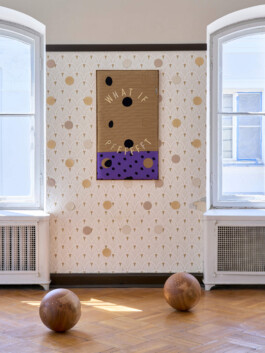
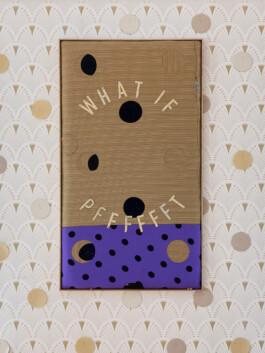
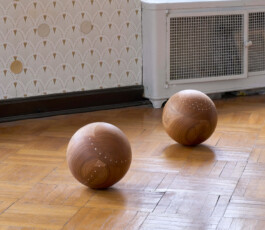
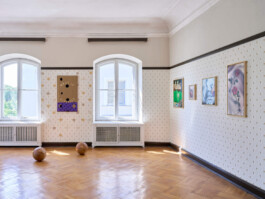
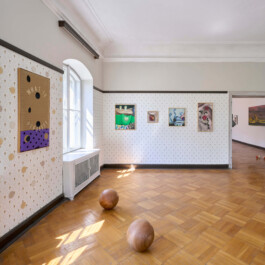
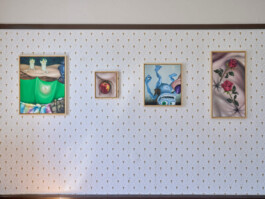
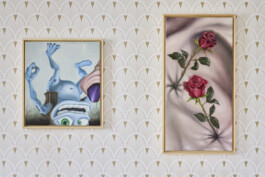
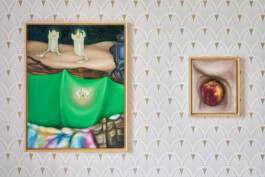
Květen 22–25 2025
artists: Valentýna Janů, Matyáš Maláč
V sérii Dots působí dílo Valentýny Janů současně svůdně i znepokojivě. Vtahuje diváka do puntíkované topologie, kde se záplaty na povrchu náhle uvolňují ze stehů a kloužou sem a tam – nejprve konvexní, poté konkávní, až se proměňují v otvory, průduchy připomínající kleiniánské portály, které převracejí vnitřek ven a vnějšek dovnitř. Je to smyslná topologie: puntík obepíná vlastní geometrii, stává se koulí a jeho měkká tkanina jemně odhaluje to, co zároveň zakrývá. Kruhy získávají další rozměr a spouští žebřík k portálu, jenž přenáší diváka dovnitř – a zároveň ven, zpět k vlastnímu tělu.
Práce Matyáše Maláče se stáčí do vlastní, šlachovité topologie. Vtahuje – méně jemně, avšak vždy hravě – do žhnoucího, synestetického světa. Úlomky internetových obrazů prorážejí záhyby psyché a obracejí ji naruby, do světa hemžícího se svéhlavými entitami. Smyslové se tu rozpadá ve jménu hyper-smyslovosti, vtělené do slov, která se zbavují významu, a přesto působí ještě těžší svou signifikancí – jako znamení doby. Vzniká paranoidní topologie, v níž otvor je otvorem, ale zároveň i něčím víc… ústy, která v sobě nesou celé světy.
Valentýna Janů (1994) je umělkyně pracující v Praze, která po studiu fotografie na FAMU pokračovala v ateliéru Intermédia II na Akademii výtvarných umění v Praze (Dušan Zahoranský, Pavla Sceranková). Ve své tvorbě využívá objekty, textilie, vzory a hru jednobarevných ploch k vytváření spekulativních prostředí, jež nenápadně vedou diváky k otázkám o propojení sexuality, ekologie a výrobních procesů. V roce 2021 získala prestižní Cenu Jindřicha Chalupeckého a v posledních letech vystavovala v Praze, Vídni, Budapešti a dalších evropských městech.
Matyáš Maláč je absolventem Akademie výtvarných umění v Praze (2023), kde studoval v ateliéru Malba II u Vladimíra Skrepla. Jeho tvorba je bohatá co do objemu i záběru; těžištěm je malba, avšak zasahuje do celé řady médií. Inspirován širokým spektrem umělců i teoretiků zkoumá postavení umění po post-internetové éře a pohybuje se na pomezí post-internetové a novoromantické tendence. Jeho kompozice jsou formálně expanzivní a spojují různé styly i techniky. V posledních letech vystavoval v Praze, Vídni, New Yorku, Athénách, Istanbulu a na dalších místech.
Text: Andrew Wilson
Pop-Up Show
16. 01. – 31. 01. 2025
Opening 16. 01. 2025 / 18:00
opening hours:
Monday to Friday: 9:00–18:00
Saturday - Sunday: 12:00–18:00
Viadukt Karlin
Prvního pluku 205/23,
186 00 Praha 8-Karlín
Curators:
Piotr Sikora
Antonín Jirát
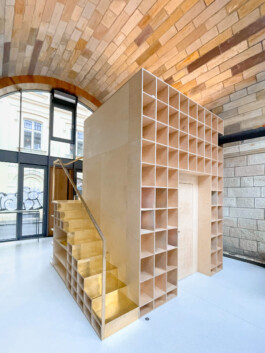
The exhibition Off to a Good Start at Viadukt Karlín presents works by thirteen artists, all of whom collaborate with Superpositions.
The criteria for the chosen works revolves around an exploration of aesthetic conventions and the construction of narratives informed by a broad spectrum of diverse aesthetic tendencies: from the polished and beautiful to the expressive, from the refined to the primal.
In this exhibition Viadukt Karlin becomes a venue for exhibiting works that are diverse both thematically and visually. Within this wide spectrum of aesthetics, a theme emerges that transcends the stereotypical perception of contemporary art.
The carefully designed and highly aesthetic space inside arch 36 of the Negrelli Viaduct often contrasts with works that oppose it, creating a vibrant mix of different media, visualities, and tendencies.
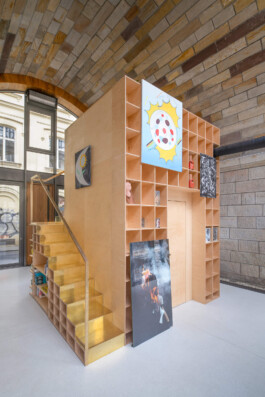
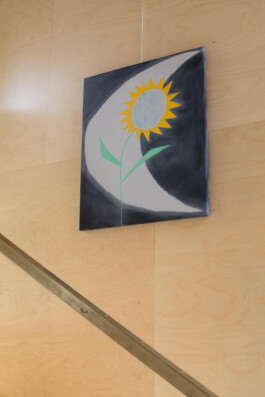
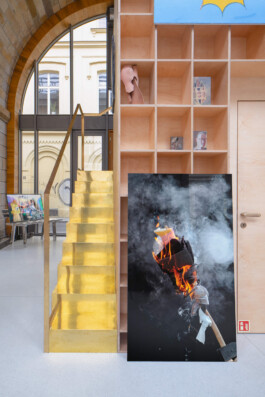
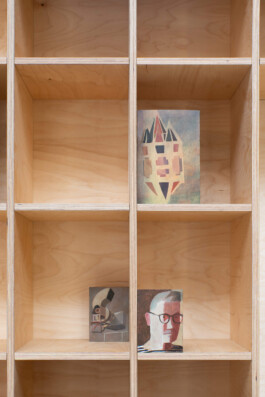
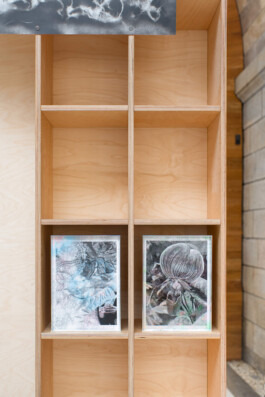
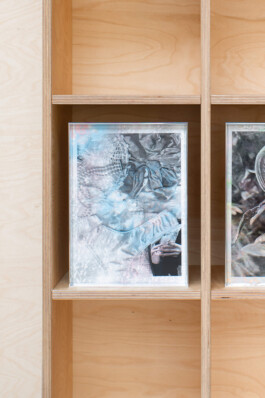
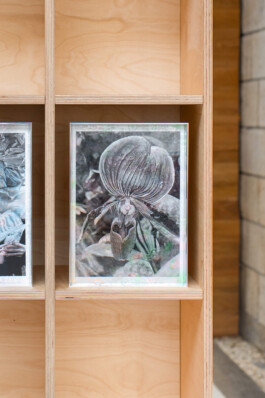
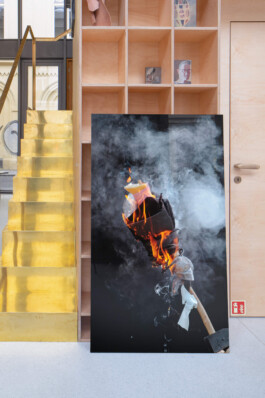
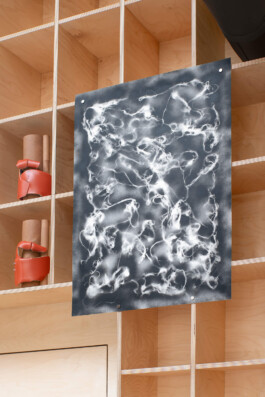
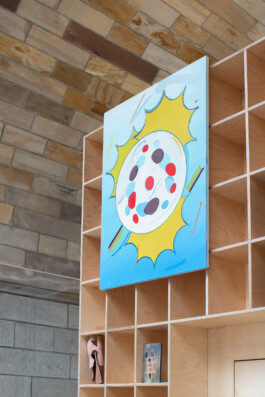
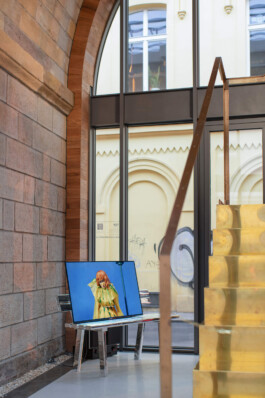
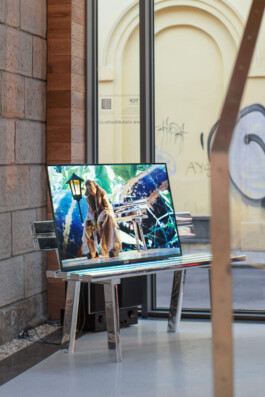
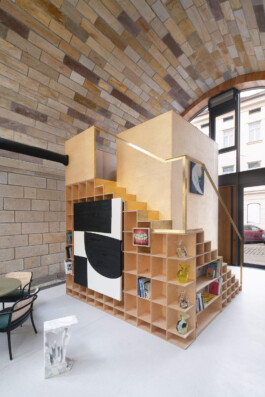
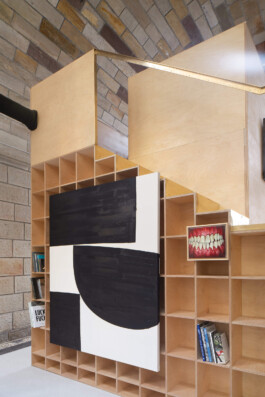
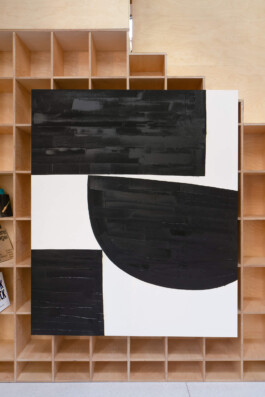
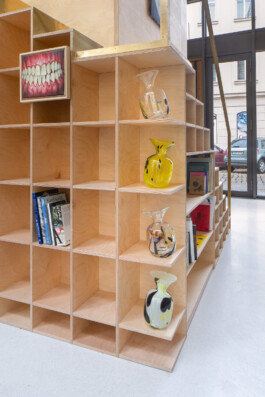
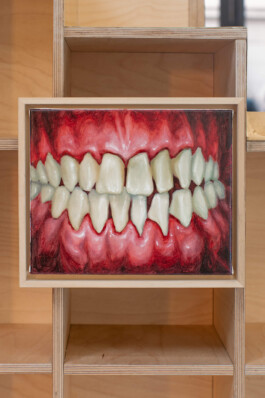
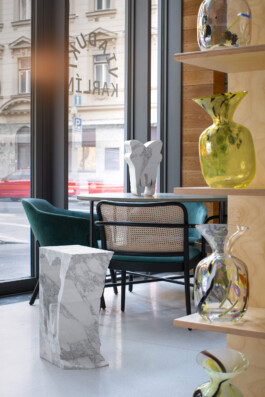
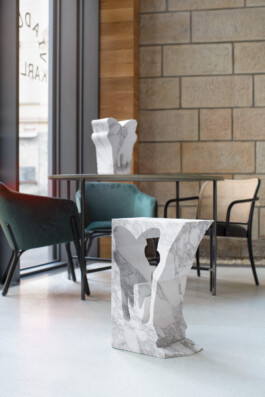
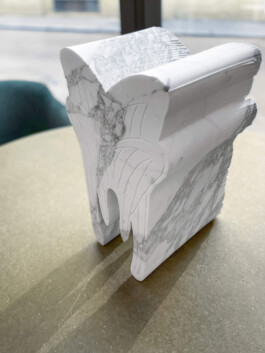
Olga krykun:
FORGET-ME-NOTS, 60 X 70 CM, DYE, PASTEL ON CANVAS, 2022
Vasil artamonov:
top: LANTERN, 24 X 15 CM, OIL ON PLYWOOD, 2024
left: AIR ENGINEERING, 10,5 X 14,8 CM, OIL ON PLYWOOD, 2023
right: SELF-PORTRAIT, 10,5 X 14,8 CM, OIL ON PLYWOOD, 2023
bety krňanská:
left: Have we met before, 24 × 30 cm, SPRAY PAINT, DIGITAL COLLAGE AND PRINT
ON TRANSPARENT FOIL, ALUMINUM FRAME, 2024
right: Come Closer, 24 × 30 cm, SPRAY PAINT, DIGITAL COLLAGE
AND PRINT ON TRANSPARENT FOIL, ALUMINUM FRAME, 2024
bety krňanská:
Have we met before, 24 × 30 cm, SPRAY PAINT, DIGITAL COLLAGE AND PRINT ON TRANSPARENT FOIL, ALUMINUM FRAME, 2024
bety krňanská:
Come Closer, 24 × 30 cm, SPRAY PAINT, DIGITAL COLLAGE AND PRINT
ON TRANSPARENT FOIL, ALUMINUM FRAME, 2024
Iveta Schovancová, Hynek Alt:
Small Talks with Fire, 80 x 140 cm, digital photograph, 2023
jan zdvořák:
UNTITLED, 61 X 86 CM, SPRAY PAINT ON PAPER, 2023
tomáš absolon:
Tonto, 90 × 120 cm, oil on canvas, 2024
selmeci kocka jusko:
Sample 0008 (Hand Holding a Scroll), PLASTIC, LEATHER,
METRIC SCREWS, 3d print, 18 × 10 × 33 cm, 2020
selmeci kocka jusko:
Sample 0007 (Hand Holding a Scroll), PLASTIC, LEATHER,
METRIC SCREWS, 3d print, 13 × 12 × 28 cm, 2020
Sample 0006 (Hand Holding a Scroll), PLASTIC, LEATHER,
METRIC SCREWS, 3d print, 13 × 12 × 28 cm, 2020
Jakub Jansa:
PUMPKINVILLE, A SHORT FILM (15MINS, 4K) COMMISSIONED BY STEIRISCHER HERBST, 2024
Jakub Jansa:
PUMPKINVILLE, A SHORT FILM (15MINS, 4K) COMMISSIONED BY STEIRISCHER HERBST, 2024
David krňanský:
Untitled, 150 × 180 cm, oil on canvas, 2024
valentýna janů:
Derek, HAND-BLOWED GLASS, 22 × 18 × 18 cm, 2021
Donna, HAND-BLOWED GLASS, 22 × 18 × 18 cm, 2021
valentýna janů:
ron, HAND-BLOWED GLASS, 22 × 18 × 18 cm, 2021
gilles, HAND-BLOWED GLASS, 22 × 18 × 18 cm, 2021
Matyáš maláč:
Spokesman, 30 × 25 cm, oil on canvas, 2024
tereza štětinová:
TEETH / WINGS, ARABESQUE MARBLE (CARRARA AREA) 2024
tereza štětinová:
TEETH / WINGS, ARABESQUE MARBLE (CARRARA AREA) 2024
tereza štětinová:
TEETH / WINGS, ARABESQUE MARBLE (CARRARA AREA) 2024
Pop-Up Show
16. 01. – 31. 01. 2025
Opening 16. 01. 2025 / 18:00
opening hours:
Monday to Friday: 9:00–18:00
Saturday - Sunday: 12:00–18:00
Viadukt Karlin
Prvního pluku 205/23,
186 00 Praha 8-Karlín
Curators:
Piotr Sikora
Antonín Jirát
The exhibition Off to a Good Start at Viadukt Karlín presents works by thirteen artists, all of whom collaborate with Superpositions.
The criteria for the chosen works revolves around an exploration of aesthetic conventions and the construction of narratives informed by a broad spectrum of diverse aesthetic tendencies: from the polished and beautiful to the expressive, from the refined to the primal.
In this exhibition Viadukt Karlin becomes a venue for exhibiting works that are diverse both thematically and visually. Within this wide spectrum of aesthetics, a theme emerges that transcends the stereotypical perception of contemporary art.
The carefully designed and highly aesthetic space inside arch 36 of the Negrelli Viaduct often contrasts with works that oppose it, creating a vibrant mix of different media, visualities, and tendencies.
Olga krykun:
FORGET-ME-NOTS, 60 X 70 CM, DYE, PASTEL ON CANVAS, 2022
Vasil artamonov:
top: LANTERN, 24 X 15 CM, OIL ON PLYWOOD, 2024
left: AIR ENGINEERING, 10,5 X 14,8 CM, OIL ON PLYWOOD, 2023
right: SELF-PORTRAIT, 10,5 X 14,8 CM, OIL ON PLYWOOD, 2023
bety krňanská:
left: Have we met before, 24 × 30 cm, SPRAY PAINT, DIGITAL COLLAGE AND PRINT
ON TRANSPARENT FOIL, ALUMINUM FRAME, 2024
right: Come Closer, 24 × 30 cm, SPRAY PAINT, DIGITAL COLLAGE
AND PRINT ON TRANSPARENT FOIL, ALUMINUM FRAME, 2024
bety krňanská:
Have we met before, 24 × 30 cm, SPRAY PAINT, DIGITAL COLLAGE AND PRINT ON TRANSPARENT FOIL, ALUMINUM FRAME, 2024
bety krňanská:
Come Closer, 24 × 30 cm, SPRAY PAINT, DIGITAL COLLAGE AND PRINT
ON TRANSPARENT FOIL, ALUMINUM FRAME, 2024
Iveta Schovancová, Hynek Alt:
Small Talks with Fire, 80 x 140 cm, digital photograph, 2023
jan zdvořák:
UNTITLED, 61 X 86 CM, SPRAY PAINT ON PAPER, 2023
tomáš absolon:
Tonto, 90 × 120 cm, oil on canvas, 2024
selmeci kocka jusko:
Sample 0008 (Hand Holding a Scroll), PLASTIC, LEATHER,
METRIC SCREWS, 3d print, 18 × 10 × 33 cm, 2020
selmeci kocka jusko:
Sample 0007 (Hand Holding a Scroll), PLASTIC, LEATHER,
METRIC SCREWS, 3d print, 13 × 12 × 28 cm, 2020
Sample 0006 (Hand Holding a Scroll), PLASTIC, LEATHER,
METRIC SCREWS, 3d print, 13 × 12 × 28 cm, 2020
Jakub Jansa:
PUMPKINVILLE, A SHORT FILM (15MINS, 4K) COMMISSIONED BY STEIRISCHER HERBST, 2024
Jakub Jansa:
PUMPKINVILLE, A SHORT FILM (15MINS, 4K) COMMISSIONED BY STEIRISCHER HERBST, 2024
David krňanský:
Untitled, 150 × 180 cm, oil on canvas, 2024
valentýna janů:
Derek, HAND-BLOWED GLASS, 22 × 18 × 18 cm, 2021
Donna, HAND-BLOWED GLASS, 22 × 18 × 18 cm, 2021
valentýna janů:
ron, HAND-BLOWED GLASS, 22 × 18 × 18 cm, 2021
gilles, HAND-BLOWED GLASS, 22 × 18 × 18 cm, 2021
Matyáš maláč:
Spokesman, 30 × 25 cm, oil on canvas, 2024
tereza štětinová:
TEETH / WINGS, ARABESQUE MARBLE (CARRARA AREA) 2024
tereza štětinová:
TEETH / WINGS, ARABESQUE MARBLE (CARRARA AREA) 2024
tereza štětinová:
TEETH / WINGS, ARABESQUE MARBLE (CARRARA AREA) 2024

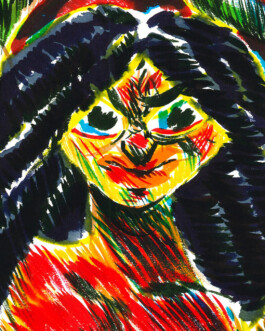


Clauda is a contemporary art gallery located in Prague’s Letná district. Founded in 2025 by Antonín Jirát. The gallery represents both emerging and established artists from the Czech Republic and abroad. Clauda has strong ties to the local cultural scene and actively helps artists forge connections with foreign markets and institutions.
Photo: Michal Ureš, 2025
Text: Emma Hanzlíková
Opening: June 19, 2026 / from 6p.m.
June 20 – July 18, 2026
Olga Krykun, STARDUST FOR TOMORROW, 110 X 130 CM, ACRYLICS AND PASTEL ON CANVAS, 2026
Clauda is pleased to present new works by Olga Krykun in her exhibition Stardust for Tomorrow.
Although it may not be apparent at first glance, the smiling sunflowers painted by Olga Krykun (1994), a Czech artist of Ukrainian origin, conceal themes of war. The glittering flowers, melancholic girls’ faces with smudged makeup, and fluffy dogs evoking 1990s stationery are inspired by the kitschy souvenirs that are imported from Asia by the shipload and sold at the market in Krykun’s hometown of Odessa. A vision of unending war intertwines with the tacky aesthetics of Chinese trinkets in the artist’s washed paintings, which symbolize childlike innocence while at the same time making an urgent, emotional appeal for individuals to bring about radical changes in our society.
While it is tempting to view Krykun’s works in the context of the Japanese aesthetic of kawaii—a perspective further encouraged by her residencies in the cities of Matsudo and Yamanashi on the island of Honshu—this is not the only way to interpret them. Krykun’s painterly themes confirm that this naive, unconscious cuteness must be recognized as a highly ironic and critical commentary on contemporary society. The mechanism of cuteness relies on the viewer’s empathy, offering an apparent sense of security in exchange. The artist tells viewers a poetic story of comforting flowers, but upon closer inspection we discover that their stems are skeletons. Krykun’s paintings remind us of something we may have forgotten: that there is a thin line between cuteness and pain. Despite the lighthearted visuality evoking digital filters used to edit selfies into a Lolita-like aesthetic of pink hues and glitter, the motifs drawn from East Slavic folklore convey serious, authentic experiences connected with the invasion and occupation of Ukraine by the Russian regime.
The work Stardust for Tomorrow, whose title became the motif of the exhibition, embodies both joy and sorrow. On the one hand, soldiers who liberate a city from a tyrant are welcomed and crowned with flowers; on the other hand, flowers are placed on their graves. Flowers are used as symbols in ceremonies of both celebration and mourning. They are a part of life and death. For 1960s hippie culture they were an emblem of peace, accompanied by the famous slogan “Flowers, not bombs.” Just as flowers are fleeting, so too is dust or sand, which Buddhist monks spend days and weeks shaping grain by grain into elaborate mandala patterns, only to then scatter them with a single breath or sweep of the hand once completed. Delicate flowers and invisible stardust both evoke the Japanese concept of mono no aware, which is not far removed from the European understanding of vanitas. It is a plaintive, melancholic emotion evoked by things that are beautiful yet fleeting, such as elusive childhood memories, flowers, Chinese souvenirs, or freedom.
Emma Hanzlíková
_______________
Krykun uses a diverse array of media within her practice, including video, objects and painting, which she subsequently assembles to create complex installations. By combining elements of fictional narratives with references to cultural and socially relevant symbols, she invents a self-contradicting mythology of our day-and-age. Krykun’s work is heavily informed by her experiences growing up in her family’s souvenir shop during a swiftly globalizing 1990s Ukraine.
Her practice, which is strongly rooted in intuition and emotion, serves as a kind of poetry for the times we live in.
Exhibitions: Gemini Season (2025), Galerii NoD, Praha (2025), 427 Gallery, Riga (2023), Wanda Gallery, Varšava (2022), Skala Gallery, Poznaň (2022), Gallery Konstfack, Stockholm (2020) a City Surfer Office, Praha (2018).
Group exhibitions: Gen-Z, MO Museum in Vilnius (2026, Ulstrup Gallery, Dánsko (2025), MXM Galeria, Madrid (2025), DSC Gallery, Praha (2025), Muzeu moderního umění ve Varšavě (2023), Českém centru v Soulu (2022), Garage Gallery, Praha (2021) a v Yo-Chang Art Museum na Tchaj-wanu (2019).
Text: Emma Hanzlíková
Opening: June 19, 2026 / from 6p.m.
June 20 – July 18, 2026
Olga Krykun, STARDUST FOR TOMORROW, 110 X 130 CM, ACRYLICS AND PASTEL ON CANVAS, 2026
Clauda is pleased to present new works by Olga Krykun in her exhibition Stardust for Tomorrow.
Although it may not be apparent at first glance, the smiling sunflowers painted by Olga Krykun (1994), a Czech artist of Ukrainian origin, conceal themes of war. The glittering flowers, melancholic girls’ faces with smudged makeup, and fluffy dogs evoking 1990s stationery are inspired by the kitschy souvenirs that are imported from Asia by the shipload and sold at the market in Krykun’s hometown of Odessa. A vision of unending war intertwines with the tacky aesthetics of Chinese trinkets in the artist’s washed paintings, which symbolize childlike innocence while at the same time making an urgent, emotional appeal for individuals to bring about radical changes in our society.
While it is tempting to view Krykun’s works in the context of the Japanese aesthetic of kawaii—a perspective further encouraged by her residencies in the cities of Matsudo and Yamanashi on the island of Honshu—this is not the only way to interpret them. Krykun’s painterly themes confirm that this naive, unconscious cuteness must be recognized as a highly ironic and critical commentary on contemporary society. The mechanism of cuteness relies on the viewer’s empathy, offering an apparent sense of security in exchange. The artist tells viewers a poetic story of comforting flowers, but upon closer inspection we discover that their stems are skeletons. Krykun’s paintings remind us of something we may have forgotten: that there is a thin line between cuteness and pain. Despite the lighthearted visuality evoking digital filters used to edit selfies into a Lolita-like aesthetic of pink hues and glitter, the motifs drawn from East Slavic folklore convey serious, authentic experiences connected with the invasion and occupation of Ukraine by the Russian regime.
The work Stardust for Tomorrow, whose title became the motif of the exhibition, embodies both joy and sorrow. On the one hand, soldiers who liberate a city from a tyrant are welcomed and crowned with flowers; on the other hand, flowers are placed on their graves. Flowers are used as symbols in ceremonies of both celebration and mourning. They are a part of life and death. For 1960s hippie culture they were an emblem of peace, accompanied by the famous slogan “Flowers, not bombs.” Just as flowers are fleeting, so too is dust or sand, which Buddhist monks spend days and weeks shaping grain by grain into elaborate mandala patterns, only to then scatter them with a single breath or sweep of the hand once completed. Delicate flowers and invisible stardust both evoke the Japanese concept of mono no aware, which is not far removed from the European understanding of vanitas. It is a plaintive, melancholic emotion evoked by things that are beautiful yet fleeting, such as elusive childhood memories, flowers, Chinese souvenirs, or freedom.
Emma Hanzlíková
_______________
Krykun uses a diverse array of media within her practice, including video, objects and painting, which she subsequently assembles to create complex installations. By combining elements of fictional narratives with references to cultural and socially relevant symbols, she invents a self-contradicting mythology of our day-and-age. Krykun’s work is heavily informed by her experiences growing up in her family’s souvenir shop during a swiftly globalizing 1990s Ukraine.
Her practice, which is strongly rooted in intuition and emotion, serves as a kind of poetry for the times we live in.
Exhibitions: Gemini Season (2025), Galerii NoD, Praha (2025), 427 Gallery, Riga (2023), Wanda Gallery, Varšava (2022), Skala Gallery, Poznaň (2022), Gallery Konstfack, Stockholm (2020) a City Surfer Office, Praha (2018).
Group exhibitions: Gen-Z, MO Museum in Vilnius (2026, Ulstrup Gallery, Dánsko (2025), MXM Galeria, Madrid (2025), DSC Gallery, Praha (2025), Muzeu moderního umění ve Varšavě (2023), Českém centru v Soulu (2022), Garage Gallery, Praha (2021) a v Yo-Chang Art Museum na Tchaj-wanu (2019).
Author's text
Opening: May 14, 2026 / from 6p.m.
May 15 – June 13, 2026
Alexey Klyuykov, TOWER, 20X13CM, OIL ON PANEL, 2026
Disrupted Horizon presents a cross section of paintings on the border between construction and disintegration. Fragments of construction sites, landscapes, and ruins come together to form images in which reality is slightly skewed.
In the background a sense of disorientation emerges—the moment when faith wanes, leaving nothing but silent wandering through the space between what remains unfinished and what has already ceased to exist.
Alexey Klyuykov (*1983, Vladimir, RU) is an artist and illustrator. He has long collaborated with Vasil Artamonov, and as a duo they won the 2010 Jindřich Chalupecký Award. Klyuykov focuses predominantly on painting, with an interest in the concept of realism in twentieth-century art as well as its contemporary possibilities.
He has collaborated as an illustrator with a range of periodicals, publishing houses, cultural institutions, and architecture studios. He lives and works in Prague.
Representation in collections: National Gallery Prague, Prague City Gallery, Gallery of Modern Art in Hradec Králové
Selection of exhibition projects: Lessons from Realism, Display, Prague, 2024, Manuš Means Human, Kunsthalle Wien, 2021 (with the Averklub Collective), Dead and Alive, 9th Triennale of Contemporary Art U3, Ljubljana, 2019, Jiwa, Jakarta Biennale, 2017, 2076, OGV, Jihlava, 2011, Clay Flag, Cripta747, Torino, 2009
Author's text
Opening: May 14, 2026 / from 6p.m.
May 15 – June 13, 2026
Alexey Klyuykov, TOWER, 20X13CM, OIL ON PANEL, 2026
Disrupted Horizon presents a cross section of paintings on the border between construction and disintegration. Fragments of construction sites, landscapes, and ruins come together to form images in which reality is slightly skewed.
In the background a sense of disorientation emerges—the moment when faith wanes, leaving nothing but silent wandering through the space between what remains unfinished and what has already ceased to exist.
Alexey Klyuykov (*1983, Vladimir, RU) is an artist and illustrator. He has long collaborated with Vasil Artamonov, and as a duo they won the 2010 Jindřich Chalupecký Award. Klyuykov focuses predominantly on painting, with an interest in the concept of realism in twentieth-century art as well as its contemporary possibilities.
He has collaborated as an illustrator with a range of periodicals, publishing houses, cultural institutions, and architecture studios. He lives and works in Prague.
Representation in collections: National Gallery Prague, Prague City Gallery, Gallery of Modern Art in Hradec Králové
Selection of exhibition projects: Lessons from Realism, Display, Prague, 2024, Manuš Means Human, Kunsthalle Wien, 2021 (with the Averklub Collective), Dead and Alive, 9th Triennale of Contemporary Art U3, Ljubljana, 2019, Jiwa, Jakarta Biennale, 2017, 2076, OGV, Jihlava, 2011, Clay Flag, Cripta747, Torino, 2009
May 21 – 24, 2026
Art warsaw Villa róŽ 2026
We are delighted to announce our participation at Art Warsaw 2026.
Artists:
Olga Krykun
Martin Groch
Šimon Sýkora
More at artwarsaw.com
Thanks to the Czech Center in Warsaw for its support.
OLGA KRYKUN, STARDUST FOR TOMORROW, 110 X 130 CM, ACRYLICS PASTEL, CANVAS, 2026
MARTIN GROCH, UNTITLED (FROM THE SERIES THEY ARE UGLY BECAUSE THEY ARE ANGRY) 24 X 30 CM, WATERCOLOR ON PAPER, 2025
ŠIMON SÝKORA, UNKNOWN PLEASURES, 110 X 110 CM, OIL ON CANVAS, 2025
May 21 – 24, 2026
Art warsaw Villa róŽ 2026
We are delighted to announce our participation at Art Warsaw 2026.
Artists:
Olga Krykun
Martin Groch
Šimon Sýkora
More at artwarsaw.com
Thanks to the Czech Center in Warsaw for its support.
OLGA KRYKUN, STARDUST FOR TOMORROW, 110 X 130 CM, ACRYLICS PASTEL, CANVAS, 2026
MARTIN GROCH, UNTITLED (FROM THE SERIES THEY ARE UGLY BECAUSE THEY ARE ANGRY) 24 X 30 CM, WATERCOLOR ON PAPER, 2025
ŠIMON SÝKORA, UNKNOWN PLEASURES, 110 X 110 CM, OIL ON CANVAS, 2025
Curator Lenka Lindaurová
Opening: March 26, 2026 / 6PM – 9PM
March 27 – April 25, 2026
Iren Stehli, Prague Shop Windows, black and white photograph on baryta paper, 1978–1996
Clauda is pleased to present a solo exhibition of works by Swiss photographer Iren Stehli. This selection of photographs from an extensive collection spanning from the 1970s to today attempts to capture the timeless and poetic scenes of a single environment: city shop windows. Swiss photographer Iren Stehli, who found herself in Prague as a young student amidst the socialist aesthetics of scarcity and pettiness, recorded this environment with fascination—absurd human creativity and the charm of the unintended on the one hand and the indifference of the city’s inhabitants, herd mentality, and drabness on the other. In the period when the exhibited black-and-white photographs were taken, the main trend in analog photography was documentary. It conveyed information that was otherwise unavailable in a territory fenced off with barbed wire and closed to the media.
However, in the series Shop Windows Stehli departed from the model of the “hidden face of communist prosperity” and documented precisely what the regime boasted about and put on display. We deliberately removed politics from the selection: shop window displays supplemented their meager assortments of goods with portraits of communist statesmen, political slogans, and posters; later, in the 1990s, these were replaced by colorful prints displaying varieties of Western Coca-Cola, scantily clad beauties, or waving golden cats.
What remained? Pure beauty without intention, an empty existence, a poem without words, a message of Kafkaesque transformation. Removed from the context of the larger whole, which presents the viewer with a society unfit for living, our selection seems like the filigree of an enchanted eye. It is a document of its time, but—as already mentioned—a quite timeless one. The aim is to present the artist as a sensitive observer who works with a time-lapse approach and to find moments in her work that transcend the medium of photography. The exhibited selection present the artist—whose works in other series are filled with curious characters—as a demiurge of silent images where the only thing that remains of people is an emotional trace.
Iren Stehli (*1953 Zurich) went to Prague in 1972 to take a Czech language course for foreigners (her mother was Czech), and she later studied Slavic studies at Charles University. By chance, she fell in love with photography, and from 1974 to 1979 she studied at FAMU, where she made many lifelong friends, including the inspiring theorist Anna Fárová. Stehli was so enchanted by the Czech environment that she continued returning from Switzerland, and most of her independent work therefore relates to the Czech milieu (such as the famous series Dancing Lessons 1974–77, Fast-Food Fish 1976–77, Sláma, the Tailor 1976–81, Libuna 1974–2001, and Prague Shop Windows 1976–96).
She exhibited for the first time in 1978 at the legendary Činoherní klub, and since 1983 her work has appeared in numerous international exhibitions. In 2014, she had a solo exhibition entitled So nah, so fern at the renowned Fotostiftung Schweiz in Winterthur, and a year later her work was also presented at the Prague City Gallery. Iren Stehli’s portfolio also includes three publications of her own work. Her portfolio also includes three original publications.
Her photographs are held in many prestigious collections, including Centre Pompidou, Sammlung der Stadt Zürich, Sammlung der Stadt Biel, Moravian Gallery in Brno, and Prague City Gallery. After the Velvet Revolution in 1989, she became the director of Pro Helvetia, a foundation supporting Czech culture, which she led for eight years. She also applied for Czech citizenship, and she still divides her time between Zurich and Prague.
Iren Stehli, Prague Shop Windows, black and white photograph on baryta paper, 1978–1996
Curator Lenka Lindaurová
Opening: March 26, 2026 / 6PM – 9PM
March 27 – April 25, 2026
Iren Stehli, Prague Shop Windows, black and white photograph on baryta paper, 1978–1996
Clauda is pleased to present a solo exhibition of works by Swiss photographer Iren Stehli. This selection of photographs from an extensive collection spanning from the 1970s to today attempts to capture the timeless and poetic scenes of a single environment: city shop windows. Swiss photographer Iren Stehli, who found herself in Prague as a young student amidst the socialist aesthetics of scarcity and pettiness, recorded this environment with fascination—absurd human creativity and the charm of the unintended on the one hand and the indifference of the city’s inhabitants, herd mentality, and drabness on the other. In the period when the exhibited black-and-white photographs were taken, the main trend in analog photography was documentary. It conveyed information that was otherwise unavailable in a territory fenced off with barbed wire and closed to the media.
However, in the series Shop Windows Stehli departed from the model of the “hidden face of communist prosperity” and documented precisely what the regime boasted about and put on display. We deliberately removed politics from the selection: shop window displays supplemented their meager assortments of goods with portraits of communist statesmen, political slogans, and posters; later, in the 1990s, these were replaced by colorful prints displaying varieties of Western Coca-Cola, scantily clad beauties, or waving golden cats.
What remained? Pure beauty without intention, an empty existence, a poem without words, a message of Kafkaesque transformation. Removed from the context of the larger whole, which presents the viewer with a society unfit for living, our selection seems like the filigree of an enchanted eye. It is a document of its time, but—as already mentioned—a quite timeless one. The aim is to present the artist as a sensitive observer who works with a time-lapse approach and to find moments in her work that transcend the medium of photography. The exhibited selection present the artist—whose works in other series are filled with curious characters—as a demiurge of silent images where the only thing that remains of people is an emotional trace.
Iren Stehli (*1953 Zurich) went to Prague in 1972 to take a Czech language course for foreigners (her mother was Czech), and she later studied Slavic studies at Charles University. By chance, she fell in love with photography, and from 1974 to 1979 she studied at FAMU, where she made many lifelong friends, including the inspiring theorist Anna Fárová. Stehli was so enchanted by the Czech environment that she continued returning from Switzerland, and most of her independent work therefore relates to the Czech milieu (such as the famous series Dancing Lessons 1974–77, Fast-Food Fish 1976–77, Sláma, the Tailor 1976–81, Libuna 1974–2001, and Prague Shop Windows 1976–96).
She exhibited for the first time in 1978 at the legendary Činoherní klub, and since 1983 her work has appeared in numerous international exhibitions. In 2014, she had a solo exhibition entitled So nah, so fern at the renowned Fotostiftung Schweiz in Winterthur, and a year later her work was also presented at the Prague City Gallery. Iren Stehli’s portfolio also includes three publications of her own work. Her portfolio also includes three original publications.
Her photographs are held in many prestigious collections, including Centre Pompidou, Sammlung der Stadt Zürich, Sammlung der Stadt Biel, Moravian Gallery in Brno, and Prague City Gallery. After the Velvet Revolution in 1989, she became the director of Pro Helvetia, a foundation supporting Czech culture, which she led for eight years. She also applied for Czech citizenship, and she still divides her time between Zurich and Prague.
Iren Stehli, Prague Shop Windows, black and white photograph on baryta paper, 1978–1996
Curator Andrew Wilson
Opening: February 19, 2026 / 6PM – 9PM
Feb 20 – Mar 21, 2026
Paula Gogola, soft_sighs synthesis, Curator Andrew Wilson, photo: Eva rybářová
In the solo show soft_sighs synthesis, Paula Gogola presents a new series of works that, while departing from her usual medium of paint on canvas, rearticulate and metamorphose her motifs with a balance of strength and sensitivity. These intricately layered reliefs project Gogola’s brooding figures onto a three dimensional plane: dense muscularity unfurls into shrouded repose, razor edges of steel curve into soft, yawning angles. Cold rigidity bonds with openness, pulsating strength with discretion, temerity with fugitivity. Tensed between such polarities, the opaque vitality that marks Gogola’s expanding oeuvre is here intensified, where survival hinges on secrecy, consistency on transmutation.
“The imperative of transparency,” writes philosopher Byung-Chul Han, “suspects everything that does not submit to visibility. Therein lies its violence.” In the present, this imperative has become environmental, reproducing a systemic compulsion to exhibit, disclose, self-report. Algorithmic governance requires datasets abstracted from the soft tissue of bodies and the fragile folds of relations — discretized, compressed, knowable. This legibility becomes cruelty as the data feeds back, sticking to the surface of skins flagged for suspicion, abjection, erasure. For Gogola’s figures, seemingly contemplative and transfixed, conspicuous motion merely makes one a moving target. However, this veiled quietude does not signify withdrawal, but the drawing of battle lines elsewhere: beneath the hypervisible level of symbol and identity, and at that very infrastructural, procedural level of domination itself.
Édouard Glissant urges us to “agree not merely to the right to difference” — the highest virtue in a world where the appearance of difference keeps the engines of appropriation running — but “agree also to the right to opacity… subsistence within an irreducible singularity.” Concealment generates new interiorities, spaces of experimentation and transformation that transcend individual identity: “opacities can coexist and converge, weaving fabrics.” Facing one another with heads turned away, an intimate, possibly psychic communication transpires between the figures at the level of gesture, posture, inclination. A weave of opacity that bonds its communicants in an alliance whose means of survival, be it hiddenness, fugitivity, or subversion, is never mistaken for an end. Knowledge of that end, encrypted in prophecy and distributed in partial avowals, is foreclosed to those for whom knowledge is only ever instrumental. Yet this inaccessibility may also contain an invitation; a provocation to slip behind the darkening veil, to refuse the threshold of permissible existence…
Paula Gogola (*1998, Banská Bystrica) works primarily in the medium of painting. In the spirit of queer and feminist thinking, she observes the body as a changing form that is shaped by personal experience, cultural narratives, and speculative means. The main themes of her work include hormonal transformation, contamination, desire, and care, which she conveys through a delicate, atmospheric visual language. She received her bachelor's degree from Klaudia Kosziba's painting studio at the Academy of Fine Arts and Design in Bratislava. She completed her master's degree at the Painting 3 studio at the Academy of Fine Arts and Design in Prague under the guidance of Josef Bolfa and Jakub Hošek. During her studies, she completed several internships, both at the Academy of Arts, Architecture and Design in Prague (in Dominik Lang's sculpture studio and Michal Pěchouček and Dominik Gajarský's intermedia studio) and abroad at Beaux-Arts Paris (in a studio led by Mimosa Echard). Gogola has presented her work at numerous group exhibitions at home and abroad; for example, at Aurora Vessels at the ACUD Gallery in Berlin (2025), at Crash Club Projects in Warsaw (2024), and at the exhibition The rotten smell is you at Kunsthalle Bratislava (2023). She has presented her work independently at the exhibitions Leering Despondency (VUNU, Bratislava, 2024), Begone Estrone (together with Natália Sýkorová, Medium Gallery, Bratislava, 2025), and With feathers and flesh (together with Hanna Antonsson, Holešovická šachta, Prague, 2025). This year, she won first place in the 20th edition of the Slovak competition Maľba 2025.
Paula Gogola, soft_sighs synthesis, Curator Andrew Wilson, photo: Eva rybářová
Paula Gogola, soft_sighs synthesis, Curator Andrew Wilson, photo: Eva rybářová
Paula Gogola, soft_sighs synthesis, Curator Andrew Wilson, photo: Eva rybářová
Paula Gogola, soft_sighs synthesis, Curator Andrew Wilson, photo: Eva rybářová
Paula Gogola, soft_sighs synthesis, Curator Andrew Wilson, photo: Eva rybářová
Paula Gogola, soft_sighs synthesis, Curator Andrew Wilson, photo: Eva rybářová
Paula Gogola, soft_sighs synthesis, Curator Andrew Wilson, photo: Eva rybářová
Paula Gogola, soft_sighs synthesis, Curator Andrew Wilson, photo: Eva rybářová
Paula Gogola, soft_sighs synthesis, Curator Andrew Wilson, photo: Eva rybářová
Paula Gogola, soft_sighs synthesis, Curator Andrew Wilson, photo: Eva rybářová
Paula Gogola, soft_sighs synthesis, Curator Andrew Wilson, photo: Eva rybářová
Paula Gogola, soft_sighs synthesis, Curator Andrew Wilson, photo: Eva rybářová
Paula Gogola, soft_sighs synthesis, Curator Andrew Wilson, photo: Eva rybářová
Paula Gogola, soft_sighs synthesis, Curator Andrew Wilson, photo: Eva rybářová
Curator Andrew Wilson
Opening: February 19, 2026 / 6PM – 9PM
Feb 20 – Mar 21, 2026
Paula Gogola, soft_sighs synthesis, Curator Andrew Wilson, photo: Eva rybářová
In the solo show soft_sighs synthesis, Paula Gogola presents a new series of works that, while departing from her usual medium of paint on canvas, rearticulate and metamorphose her motifs with a balance of strength and sensitivity. These intricately layered reliefs project Gogola’s brooding figures onto a three dimensional plane: dense muscularity unfurls into shrouded repose, razor edges of steel curve into soft, yawning angles. Cold rigidity bonds with openness, pulsating strength with discretion, temerity with fugitivity. Tensed between such polarities, the opaque vitality that marks Gogola’s expanding oeuvre is here intensified, where survival hinges on secrecy, consistency on transmutation.
“The imperative of transparency,” writes philosopher Byung-Chul Han, “suspects everything that does not submit to visibility. Therein lies its violence.” In the present, this imperative has become environmental, reproducing a systemic compulsion to exhibit, disclose, self-report. Algorithmic governance requires datasets abstracted from the soft tissue of bodies and the fragile folds of relations — discretized, compressed, knowable. This legibility becomes cruelty as the data feeds back, sticking to the surface of skins flagged for suspicion, abjection, erasure. For Gogola’s figures, seemingly contemplative and transfixed, conspicuous motion merely makes one a moving target. However, this veiled quietude does not signify withdrawal, but the drawing of battle lines elsewhere: beneath the hypervisible level of symbol and identity, and at that very infrastructural, procedural level of domination itself.
Édouard Glissant urges us to “agree not merely to the right to difference” — the highest virtue in a world where the appearance of difference keeps the engines of appropriation running — but “agree also to the right to opacity… subsistence within an irreducible singularity.” Concealment generates new interiorities, spaces of experimentation and transformation that transcend individual identity: “opacities can coexist and converge, weaving fabrics.” Facing one another with heads turned away, an intimate, possibly psychic communication transpires between the figures at the level of gesture, posture, inclination. A weave of opacity that bonds its communicants in an alliance whose means of survival, be it hiddenness, fugitivity, or subversion, is never mistaken for an end. Knowledge of that end, encrypted in prophecy and distributed in partial avowals, is foreclosed to those for whom knowledge is only ever instrumental. Yet this inaccessibility may also contain an invitation; a provocation to slip behind the darkening veil, to refuse the threshold of permissible existence…
Paula Gogola (*1998, Banská Bystrica) works primarily in the medium of painting. In the spirit of queer and feminist thinking, she observes the body as a changing form that is shaped by personal experience, cultural narratives, and speculative means. The main themes of her work include hormonal transformation, contamination, desire, and care, which she conveys through a delicate, atmospheric visual language. She received her bachelor's degree from Klaudia Kosziba's painting studio at the Academy of Fine Arts and Design in Bratislava. She completed her master's degree at the Painting 3 studio at the Academy of Fine Arts and Design in Prague under the guidance of Josef Bolfa and Jakub Hošek. During her studies, she completed several internships, both at the Academy of Arts, Architecture and Design in Prague (in Dominik Lang's sculpture studio and Michal Pěchouček and Dominik Gajarský's intermedia studio) and abroad at Beaux-Arts Paris (in a studio led by Mimosa Echard). Gogola has presented her work at numerous group exhibitions at home and abroad; for example, at Aurora Vessels at the ACUD Gallery in Berlin (2025), at Crash Club Projects in Warsaw (2024), and at the exhibition The rotten smell is you at Kunsthalle Bratislava (2023). She has presented her work independently at the exhibitions Leering Despondency (VUNU, Bratislava, 2024), Begone Estrone (together with Natália Sýkorová, Medium Gallery, Bratislava, 2025), and With feathers and flesh (together with Hanna Antonsson, Holešovická šachta, Prague, 2025). This year, she won first place in the 20th edition of the Slovak competition Maľba 2025.
Paula Gogola, soft_sighs synthesis, Curator Andrew Wilson, photo: Eva rybářová
Paula Gogola, soft_sighs synthesis, Curator Andrew Wilson, photo: Eva rybářová
Paula Gogola, soft_sighs synthesis, Curator Andrew Wilson, photo: Eva rybářová
Paula Gogola, soft_sighs synthesis, Curator Andrew Wilson, photo: Eva rybářová
Paula Gogola, soft_sighs synthesis, Curator Andrew Wilson, photo: Eva rybářová
Paula Gogola, soft_sighs synthesis, Curator Andrew Wilson, photo: Eva rybářová
Paula Gogola, soft_sighs synthesis, Curator Andrew Wilson, photo: Eva rybářová
Paula Gogola, soft_sighs synthesis, Curator Andrew Wilson, photo: Eva rybářová
Paula Gogola, soft_sighs synthesis, Curator Andrew Wilson, photo: Eva rybářová
Paula Gogola, soft_sighs synthesis, Curator Andrew Wilson, photo: Eva rybářová
Paula Gogola, soft_sighs synthesis, Curator Andrew Wilson, photo: Eva rybářová
Paula Gogola, soft_sighs synthesis, Curator Andrew Wilson, photo: Eva rybářová
Paula Gogola, soft_sighs synthesis, Curator Andrew Wilson, photo: Eva rybářová
Paula Gogola, soft_sighs synthesis, Curator Andrew Wilson, photo: Eva rybářová
Text by Persis Bekkering
Opening: December 18, 2025 / 6PM – 9PM
Dec 19, 2025 – Jan 31, 2026
Martin Groch — They Are Ugly Because They Are Angry
The gallery is pleased to present a solo exhibition by Slovak-born artist Martin Groch. Groch currently lives in Brussels and works as an artist, cartoonist, and graphic designer. The exhibition features new works on paper titled They Are Ugly Because They Are Angry.
As part of the exhibition, Clauda will host the launch of After Giotto, Everything Went to Shit, a new publication by Persis Bekkering and Martin Groch, to be published by Utopia Libri.
BIO:
Martin Groch (1990)
is an artist, illustrator and graphic designer currently based in Brussels. Throughout his diverse practices, he is interested in the narrative expression of images, desiring to find explosive visual forms on the edge of the readable. He prefers to situate himself in the tradition of drawing and cartooning, even where he uses paint and brush, and feels strongly drawn to the publication form and the reproduced image. He is the author of Sweathearts (Abyme 2024), a typeface and comic book, published by his dear friend, the late John Morgan.
Born in Košice (Slovakia), Groch has been professionally active as a graphic designer and artist at least since 2013. He first trained in graphic techniques and typography, at Umprum in Prague among other institutions, which he left precociously. From 2019 to 2020, he was a resident at the Jan van Eyck Post-Academy for Art, Design and Reflection in Maastricht. Among his frequent collaborators are Tim+Tim Studio, Jakub Samek, Robert Jansa, Peter Bosák, and Nana Esi (Atelier Brenda).
At the invitation of prof. Natasha M. Llorens (KKH Royal Institute of Art Stockholm) in 2020, he participated in a project titled Art-Rite, reinterpreting the iconic cheap art newspaper from 70s New York. At KKH, Groch was also invited to give workshops and lectures. He has since taught at the Royal Academy of Arts Antwerp, Ensad Nancy, and in the current season, at HfG Karlsruhe. Previous exhibitions of his work include the Jan van Eyck Academy Maastricht, PLATO Ostrava, the Salone del Mobile Milan.
Persis Bekkering (NL)
is a writer and critic, engaging with a wide spectrum of artistic disciplines. She is interested in forms of expression that account for the permanence of crisis in the contemporary world. She is the author of two novels in Dutch, A Hero’s Life (2018, shortlisted for the ANV Debut Prize) and Excess (2021, shortlisted for the BNG Bank Prize for Literature). Her novella Last Utopia is published in English translation by the Jan van Eyck Academy Maastricht. As a writer, performer, conversation partner and dramaturge, she collaborates with artists such as Martin Groch, Dora García and Benjamin Abel Meirhaeghe. She also teaches creative writing at ArtEZ University of the Arts in Arnhem (NL).
.....
“Why are you drawing women so ugly?” my father asked me when I was a teenager. Around the same time, my mother remarked that drawing like this makes me one of those old men — she must have meant those sleazy, sad, or bankrupt ones from the generation of my father or older. Alcoholics, failed poets, bad fathers were around then as they are now. Both my parents must have been suspicious of what would become of me. I don't know what I answered them. I draw them like I find them most interesting.
I have been taught it is not good art to draw a black outline, to draw eyelashes, and that good artist should hold back when depicting that glitter in someone’s eyes. It was the late modernist tradition with an eastern Czechoslovak-Hungarian flavor I grew up with. That is inevitably a matter of the place and class one is born into; that was my first inheritance. And then I discovered comics. Suddenly I was invested in the opposite of the moderate, restricted modern style of painting (that style that which evidently was never meant to be restricted, but that's how it appeared to me, at that point in my life). I asked my father, who was a publisher at the time, if I could ever make money by applying ink on paper in order to create images, and he said – yes, sure.
Now I mostly use black brushstrokes. I draw make-up, jewelry, and hair, sometimes more visibly than any facial features, and my references are the kind of images meant to be read - cartoons, gothic paintings on wooden panels, or those characters in the mid-19th-century work of Wilhelm Busch, Max and Moritz. I love Krazy Kat, I like Yuichi Yokoyama and his “New Engineering,” where comics get as loud as they possibly can. I like American underground comics, I like those dancing, breathing, confused and overwhelmed characters which one might find in comics from Belgium, France, the States, Japan. There is something about that mechanical line.
I draw people as types or as specific people. I draw characters. Women, men, animals. Sometimes I doubt whether a typological depiction of figures is lazy — as I was being told —, but then again, typology is also a way of seeing, a way of catching something shared between people. Typology is not only repetition; it is also the place where the hand is balancing between something automatic and something inventive, between what is programmed and what aims to be free. Because otherwise — what is the alternative?
There is much debate about where to draw the line between drawing and painting, but I like to call what I do ‘drawing'. The history of drawing speaks to me the most. It is the closest I have come to writing. I'm always trying to hit that edge of readability. I often buy and consume a catalogue or a book accompanying a show, and that is what causes me the most joy. That is how I relate myself to so-called fine art. The format of a catalogue, a book with a reduced image quality, it tears off the aura of the work. The work of an artist is thrown into the mundane circulation of everyday life. Exciting. Reproduction flattens the work. Finally it becomes a picture plane I can orient myself in. I also feel drawn to the writing that comes with it – essays, interviews, captions. I tend to enjoy any art in that mixed form, sometimes more than the exhibition itself.
I am from a country where cartoon, as a practice, does not have its own name, and as a discipline no terms to work with. Cartooning is not reflected upon, exists just in fragments. One might aspire to be “karikaturista”, which means to do caricature, or to do “kreslený vtip”, which means to draw jokes. And who wants to be that? Yet there is something so captivating in how the pen in interaction with a sheet of paper is able to do anything within a very limited space, to depict scenes of any kind, to build mise-en-scènes. I’m sometimes telling myself this is the closest I can get to writing. To do cartoons is to count with the reader, to be read. I draw a head and it is a circle with eyes, that circle is a line and eyes are dots; I like to think “how is it possible we can read that abstract form?”
“One good reproduction is worth a thousand poor originals.” My works are rather small in format, and there is a reason for that. I want to have them scanned at the best possible quality I can achieve, in order to be able to put them to work, to make a reproduction. Standing side by side with the scanner has become something that takes up a significant part of my working time. If one looks at comics originals — American, French, Japanese, the older ones that belong to history — there is, for many, a charming mess created by functional marks: pure cyan pencil underneath the black drawing, marks left for printers and editors, notes on coloring or cropping the image. There is always the consideration of scale involved, of how much one can or should reduce a drawing to have the right impact within the chosen format. With reproduction one is losing something but there is a good and fair exchange: work that is reproduced is meant to be engaged with differently than the original; it is meant to be consumed with appetite, it is not precious. Reproduction, much like a book without a spine, has no authority.
When I made the works for “They Are Ugly Because They Are Angry,” I was not thinking about the possibility of an exhibition at all; I thought I would show them in a magazine or in some printed form or another. And so this work was always pleasurable to do, without pressure. I have an immense interest in the structural and emotional meaning of them. I happily accept it if they stay on the margin.
I have strange ambitions. I wish to be like Tove Jansson — a failed painter who was at her best making cartoons, illustrations and children’s books. I wish to have something of Carol Rama, who was fearless in drawing phalluses and unsettling women — things you don’t want to see but cannot look away from. It doesn’t feel comfortable, and it hits with the kind of impact I admire. And something of the Hernandez Brothers and their Love and Rockets series: where the characters – women – are as much typologies, shaped by a learned way of drawing, as they are alive. And body parts, in all kinds of forms, are everywhere — and they don’t mean “sex”, but even so. They’re juicy as hell. They might be angry. Not ugly at all.
Martin Groch, edited by Persis Bekkering
Martin Groch, They Are Ugly Because They Are Angry, photo Eva rybářová
Martin Groch, They Are Ugly Because They Are Angry, photo Eva rybářová
Martin Groch, They Are Ugly Because They Are Angry, photo Eva rybářová
Martin Groch, They Are Ugly Because They Are Angry, photo Eva rybářová
Martin Groch, They Are Ugly Because They Are Angry, photo Eva rybářová
Martin Groch, They Are Ugly Because They Are Angry, photo Eva rybářová
Martin Groch, They Are Ugly Because They Are Angry, photo Eva rybářová
Martin Groch, They Are Ugly Because They Are Angry, photo Eva rybářová
Martin Groch, They Are Ugly Because They Are Angry, photo Eva rybářová
Martin Groch, They Are Ugly Because They Are Angry, photo Eva rybářová
Martin Groch, They Are Ugly Because They Are Angry, photo Eva rybářová
Martin Groch, They Are Ugly Because They Are Angry, photo Eva rybářová
Martin Groch, They Are Ugly Because They Are Angry, photo Eva rybářová
Martin Groch, They Are Ugly Because They Are Angry, photo Eva rybářová
Martin Groch, They Are Ugly Because They Are Angry, photo Eva rybářová
Text by Persis Bekkering
Opening: December 18, 2025 / 6PM – 9PM
Dec 19, 2025 – Jan 31, 2026
Martin Groch — They Are Ugly Because They Are Angry
The gallery is pleased to present a solo exhibition by Slovak-born artist Martin Groch. Groch currently lives in Brussels and works as an artist, cartoonist, and graphic designer. The exhibition features new works on paper titled They Are Ugly Because They Are Angry.
As part of the exhibition, Clauda will host the launch of After Giotto, Everything Went to Shit, a new publication by Persis Bekkering and Martin Groch, to be published by Utopia Libri.
BIO:
Martin Groch (1990)
is an artist, illustrator and graphic designer currently based in Brussels. Throughout his diverse practices, he is interested in the narrative expression of images, desiring to find explosive visual forms on the edge of the readable. He prefers to situate himself in the tradition of drawing and cartooning, even where he uses paint and brush, and feels strongly drawn to the publication form and the reproduced image. He is the author of Sweathearts (Abyme 2024), a typeface and comic book, published by his dear friend, the late John Morgan.
Born in Košice (Slovakia), Groch has been professionally active as a graphic designer and artist at least since 2013. He first trained in graphic techniques and typography, at Umprum in Prague among other institutions, which he left precociously. From 2019 to 2020, he was a resident at the Jan van Eyck Post-Academy for Art, Design and Reflection in Maastricht. Among his frequent collaborators are Tim+Tim Studio, Jakub Samek, Robert Jansa, Peter Bosák, and Nana Esi (Atelier Brenda).
At the invitation of prof. Natasha M. Llorens (KKH Royal Institute of Art Stockholm) in 2020, he participated in a project titled Art-Rite, reinterpreting the iconic cheap art newspaper from 70s New York. At KKH, Groch was also invited to give workshops and lectures. He has since taught at the Royal Academy of Arts Antwerp, Ensad Nancy, and in the current season, at HfG Karlsruhe. Previous exhibitions of his work include the Jan van Eyck Academy Maastricht, PLATO Ostrava, the Salone del Mobile Milan.
Persis Bekkering (NL)
is a writer and critic, engaging with a wide spectrum of artistic disciplines. She is interested in forms of expression that account for the permanence of crisis in the contemporary world. She is the author of two novels in Dutch, A Hero’s Life (2018, shortlisted for the ANV Debut Prize) and Excess (2021, shortlisted for the BNG Bank Prize for Literature). Her novella Last Utopia is published in English translation by the Jan van Eyck Academy Maastricht. As a writer, performer, conversation partner and dramaturge, she collaborates with artists such as Martin Groch, Dora García and Benjamin Abel Meirhaeghe. She also teaches creative writing at ArtEZ University of the Arts in Arnhem (NL).
.....
“Why are you drawing women so ugly?” my father asked me when I was a teenager. Around the same time, my mother remarked that drawing like this makes me one of those old men — she must have meant those sleazy, sad, or bankrupt ones from the generation of my father or older. Alcoholics, failed poets, bad fathers were around then as they are now. Both my parents must have been suspicious of what would become of me. I don't know what I answered them. I draw them like I find them most interesting.
I have been taught it is not good art to draw a black outline, to draw eyelashes, and that good artist should hold back when depicting that glitter in someone’s eyes. It was the late modernist tradition with an eastern Czechoslovak-Hungarian flavor I grew up with. That is inevitably a matter of the place and class one is born into; that was my first inheritance. And then I discovered comics. Suddenly I was invested in the opposite of the moderate, restricted modern style of painting (that style that which evidently was never meant to be restricted, but that's how it appeared to me, at that point in my life). I asked my father, who was a publisher at the time, if I could ever make money by applying ink on paper in order to create images, and he said – yes, sure.
Now I mostly use black brushstrokes. I draw make-up, jewelry, and hair, sometimes more visibly than any facial features, and my references are the kind of images meant to be read - cartoons, gothic paintings on wooden panels, or those characters in the mid-19th-century work of Wilhelm Busch, Max and Moritz. I love Krazy Kat, I like Yuichi Yokoyama and his “New Engineering,” where comics get as loud as they possibly can. I like American underground comics, I like those dancing, breathing, confused and overwhelmed characters which one might find in comics from Belgium, France, the States, Japan. There is something about that mechanical line.
I draw people as types or as specific people. I draw characters. Women, men, animals. Sometimes I doubt whether a typological depiction of figures is lazy — as I was being told —, but then again, typology is also a way of seeing, a way of catching something shared between people. Typology is not only repetition; it is also the place where the hand is balancing between something automatic and something inventive, between what is programmed and what aims to be free. Because otherwise — what is the alternative?
There is much debate about where to draw the line between drawing and painting, but I like to call what I do ‘drawing'. The history of drawing speaks to me the most. It is the closest I have come to writing. I'm always trying to hit that edge of readability. I often buy and consume a catalogue or a book accompanying a show, and that is what causes me the most joy. That is how I relate myself to so-called fine art. The format of a catalogue, a book with a reduced image quality, it tears off the aura of the work. The work of an artist is thrown into the mundane circulation of everyday life. Exciting. Reproduction flattens the work. Finally it becomes a picture plane I can orient myself in. I also feel drawn to the writing that comes with it – essays, interviews, captions. I tend to enjoy any art in that mixed form, sometimes more than the exhibition itself.
I am from a country where cartoon, as a practice, does not have its own name, and as a discipline no terms to work with. Cartooning is not reflected upon, exists just in fragments. One might aspire to be “karikaturista”, which means to do caricature, or to do “kreslený vtip”, which means to draw jokes. And who wants to be that? Yet there is something so captivating in how the pen in interaction with a sheet of paper is able to do anything within a very limited space, to depict scenes of any kind, to build mise-en-scènes. I’m sometimes telling myself this is the closest I can get to writing. To do cartoons is to count with the reader, to be read. I draw a head and it is a circle with eyes, that circle is a line and eyes are dots; I like to think “how is it possible we can read that abstract form?”
“One good reproduction is worth a thousand poor originals.” My works are rather small in format, and there is a reason for that. I want to have them scanned at the best possible quality I can achieve, in order to be able to put them to work, to make a reproduction. Standing side by side with the scanner has become something that takes up a significant part of my working time. If one looks at comics originals — American, French, Japanese, the older ones that belong to history — there is, for many, a charming mess created by functional marks: pure cyan pencil underneath the black drawing, marks left for printers and editors, notes on coloring or cropping the image. There is always the consideration of scale involved, of how much one can or should reduce a drawing to have the right impact within the chosen format. With reproduction one is losing something but there is a good and fair exchange: work that is reproduced is meant to be engaged with differently than the original; it is meant to be consumed with appetite, it is not precious. Reproduction, much like a book without a spine, has no authority.
When I made the works for “They Are Ugly Because They Are Angry,” I was not thinking about the possibility of an exhibition at all; I thought I would show them in a magazine or in some printed form or another. And so this work was always pleasurable to do, without pressure. I have an immense interest in the structural and emotional meaning of them. I happily accept it if they stay on the margin.
I have strange ambitions. I wish to be like Tove Jansson — a failed painter who was at her best making cartoons, illustrations and children’s books. I wish to have something of Carol Rama, who was fearless in drawing phalluses and unsettling women — things you don’t want to see but cannot look away from. It doesn’t feel comfortable, and it hits with the kind of impact I admire. And something of the Hernandez Brothers and their Love and Rockets series: where the characters – women – are as much typologies, shaped by a learned way of drawing, as they are alive. And body parts, in all kinds of forms, are everywhere — and they don’t mean “sex”, but even so. They’re juicy as hell. They might be angry. Not ugly at all.
Martin Groch, edited by Persis Bekkering
Martin Groch, They Are Ugly Because They Are Angry, photo Eva rybářová
Martin Groch, They Are Ugly Because They Are Angry, photo Eva rybářová
Martin Groch, They Are Ugly Because They Are Angry, photo Eva rybářová
Martin Groch, They Are Ugly Because They Are Angry, photo Eva rybářová
Martin Groch, They Are Ugly Because They Are Angry, photo Eva rybářová
Martin Groch, They Are Ugly Because They Are Angry, photo Eva rybářová
Martin Groch, They Are Ugly Because They Are Angry, photo Eva rybářová
Martin Groch, They Are Ugly Because They Are Angry, photo Eva rybářová
Martin Groch, They Are Ugly Because They Are Angry, photo Eva rybářová
Martin Groch, They Are Ugly Because They Are Angry, photo Eva rybářová
Martin Groch, They Are Ugly Because They Are Angry, photo Eva rybářová
Martin Groch, They Are Ugly Because They Are Angry, photo Eva rybářová
Martin Groch, They Are Ugly Because They Are Angry, photo Eva rybářová
Martin Groch, They Are Ugly Because They Are Angry, photo Eva rybářová
Martin Groch, They Are Ugly Because They Are Angry, photo Eva rybářová
Text by Adéla Janíčková
Opening: November 5, 2025 / 6PM – 9PM
Nov 6 – Dec 12, 2025
Lashes, 51 X 66 CM, GRAPHITE ON PAPER, 2023, PHOTO AUTHOR'S ARCHIVE
We cordially invite you to the exhibition of Julie Daňhelová's exhibition Unearth Me.
The black-and-white drawings of Julie Daňhelová balance between historical document and fantastical imagination. Her works are mounted in custom-made frames, often adorned with original carvings. Her art practice extends beyond paper to include in-situ installations – objects that evoke alchemical experiments and silent rituals.
Drawn with delicate graphite pencil on handmade paper, Daňhelová’s works fascinate with their perfection. Although the elaborate execution may appear as a result of meticulous preparation, their precision and rhythm emerge from an intense focus – from a meditative state of mind in which thought, hand, and paper become one. The drawing itself leads the process. What unfolds are mysterious environments filled with intricate details and encoded meanings. The scenes may resemble hermetic images, conveying deep wisdom. The artist’s work with paper reinforces this transmission of knowledge; though fragile, paper has served since ancient times as a tool of civilizations to leave their imprint on history.
From the Ore Mountains come stories of how people once subdued the landscape, and at the same time how the landscape quietly shapes human lives. Starting in the sixteenth century, the Ore Mountains experienced a mining fever. People from all over Europe – Venetians, Saxons, Czechs – came to the region, united by the vision of gaining wealth from the metal in the earth’s depths. Everything born here has been repeatedly extracted, plundered, and rediscovered. The burdensome history of the Sudetenland transforms in the artist’s drawings into a poetry of fateful cycles, an endless excavation of the memory of people and places.
During this period, a gentler Ore Mountains tradition came into being – bobbin lace. The entrepreneur, philanthropist, and pioneer of Ore Mountain lace-making, Barbara Uthmann from Annaberg, provided work for hundreds of women and later also for the male miners themselves, who in the evenings, when winter closed the mines, spun threads instead of ore to earn extra income. The contrast between the hard labor in the depths and the delicate movement of hands creating webs of thread is essential for Julie Daňhelová: two sides of the same coin, two ways in which a person transforms matter – and themselves.
Fragments of the past appear on the frames themselves, decorated with chipped pieces of mother-of-pearl. It was from these shells that ornamental buttons used to be made in Kraslice, where Julie has been spending her time since childhood. The leftovers from home production ended up scattered throughout the landscape. Julie finds the discarded material and incorporates it into her works as a memento of what once connected people to their land. The cassetta frames, forming a whole with the drawings, are created in collaboration with Kryštof Kučera and become original artefacts – another layer in the story of transformation and continuity.
Her work with materials evokes an alchemical process – the transmutation of found fragments into new forms that carry both awareness and purification. Mining becomes a metaphor for uncovering layers and transformation – the reshaping of matter as well as of the past. Here, art becomes a process of sublimation through which the artist regenerates the soil and the soul of both place and people. The ghosts of the Ore Mountains are not shadows of the past but a living presence around and within us, with whom Julie engages in a silent dialogue. The exhibition title Unearth me symbolically calls for rediscovery and understanding.
The land is both an archive and a warning. In a time when the prospect of lithium mining is once again discussed, her work serves as a reminder that the earth is not an inexhaustible resource, but a living body to which we are bound by responsibility and memory.
Adéla Janíčková
Text by Adéla Janíčková
Opening: November 5, 2025 / 6PM – 9PM
Nov 6 – Dec 12, 2025
Lashes, 51 X 66 CM, GRAPHITE ON PAPER, 2023, PHOTO AUTHOR'S ARCHIVE
We cordially invite you to the exhibition of Julie Daňhelová's exhibition Unearth Me.
The black-and-white drawings of Julie Daňhelová balance between historical document and fantastical imagination. Her works are mounted in custom-made frames, often adorned with original carvings. Her art practice extends beyond paper to include in-situ installations – objects that evoke alchemical experiments and silent rituals.
Drawn with delicate graphite pencil on handmade paper, Daňhelová’s works fascinate with their perfection. Although the elaborate execution may appear as a result of meticulous preparation, their precision and rhythm emerge from an intense focus – from a meditative state of mind in which thought, hand, and paper become one. The drawing itself leads the process. What unfolds are mysterious environments filled with intricate details and encoded meanings. The scenes may resemble hermetic images, conveying deep wisdom. The artist’s work with paper reinforces this transmission of knowledge; though fragile, paper has served since ancient times as a tool of civilizations to leave their imprint on history.
From the Ore Mountains come stories of how people once subdued the landscape, and at the same time how the landscape quietly shapes human lives. Starting in the sixteenth century, the Ore Mountains experienced a mining fever. People from all over Europe – Venetians, Saxons, Czechs – came to the region, united by the vision of gaining wealth from the metal in the earth’s depths. Everything born here has been repeatedly extracted, plundered, and rediscovered. The burdensome history of the Sudetenland transforms in the artist’s drawings into a poetry of fateful cycles, an endless excavation of the memory of people and places.
During this period, a gentler Ore Mountains tradition came into being – bobbin lace. The entrepreneur, philanthropist, and pioneer of Ore Mountain lace-making, Barbara Uthmann from Annaberg, provided work for hundreds of women and later also for the male miners themselves, who in the evenings, when winter closed the mines, spun threads instead of ore to earn extra income. The contrast between the hard labor in the depths and the delicate movement of hands creating webs of thread is essential for Julie Daňhelová: two sides of the same coin, two ways in which a person transforms matter – and themselves.
Fragments of the past appear on the frames themselves, decorated with chipped pieces of mother-of-pearl. It was from these shells that ornamental buttons used to be made in Kraslice, where Julie has been spending her time since childhood. The leftovers from home production ended up scattered throughout the landscape. Julie finds the discarded material and incorporates it into her works as a memento of what once connected people to their land. The cassetta frames, forming a whole with the drawings, are created in collaboration with Kryštof Kučera and become original artefacts – another layer in the story of transformation and continuity.
Her work with materials evokes an alchemical process – the transmutation of found fragments into new forms that carry both awareness and purification. Mining becomes a metaphor for uncovering layers and transformation – the reshaping of matter as well as of the past. Here, art becomes a process of sublimation through which the artist regenerates the soil and the soul of both place and people. The ghosts of the Ore Mountains are not shadows of the past but a living presence around and within us, with whom Julie engages in a silent dialogue. The exhibition title Unearth me symbolically calls for rediscovery and understanding.
The land is both an archive and a warning. In a time when the prospect of lithium mining is once again discussed, her work serves as a reminder that the earth is not an inexhaustible resource, but a living body to which we are bound by responsibility and memory.
Adéla Janíčková
Text by Eva Slabá
Opening: Sep 11 / 6 pm – 9 pm
Sep 12 – Oct 25 2025
VASIL ARTAMONOV, MONSTERA, INSTALLATION VIEW, 2025, PHOTO LUKÁŠ HAVLENA
Vasil Artamonov’s latest series of paintings depicts scenes from everyday urban life: a glimpse into an office building, a still life with lilies, a portrait of a pigeon. The very title of the exhibition suggests that these are banal motifs, but their simplicity conceals deeper layers of unease. A typical example is the monstera—nowadays it is a neutral houseplant decorating corporate open spaces, the hallways of apartment buildings, and various waiting rooms, but not so long ago it was perceived as a strangely shaped and slightly frightening “monster.” Artamonov plucks it from its decorative context and uses it as a metaphorical tool to highlight the latent tension hidden beneath the surface of normality, as he also did, for example, with the motif of the collection and processing of personal data, which he dealt with in previous cycles. His canvases thus featured data storage towers, omniscient birds, and schematics for monitoring devices resembling ahistorical symbols. In this exhibition, Artamonov has opted for a line of inquiry that, while similar in content, is different and more straightforward.
The canvas with a larger-than-life pigeon builds on the aforementioned contemplation of the intertwining of different planes of contemporary cosmopolitan experience. Cornelia Sollfrank and Felix Stalder also clearly highlight this entanglement in their book Contemporaneity in Embodied Data Practices (2025), where, in addition to describing individual, natural, and historical-cultural levels, they also identify a technological-data plane. The authors illustrate this idea using a study on the rewilding of migratory birds: The birds are tagged with tracking devices, and, thanks to the data they collect, the animals can then be released back into the wild without further human intervention. This creates a new type of relationship between the living, the non-living, and the technological, which under certain conditions can take on symbiotic qualities. The opposite mechanism can be observed in pigeons: While in ancient times they were valued as tireless messengers with the exceptional ability to navigate across hundreds of kilometers, with the development of technology they were gradually reclassified as unwanted urban pests. Next to disused balconies covered in bird droppings and hallway corners decorated with monsteras, we see coffee tables with vases of lilies, which have been analogously pushed aside. Their pungent scent, richly colored pollen, and potential toxicity have transformed these once-revered flowers, which have strong spiritual symbolism, into outdated gifts that do not fit into the sterile framework of contemporary professionalism.
Alongside the bird and plant motifs, we can ultimately trace this connection in the image of an office building. In the scope of residency programs, artists are increasingly entering into corporate environments in the role of consultants who are expected to provide a critical and humanizing perspective. In this context, we can recall Elvia Wilk’s novel Oval (2019), in which an artist develops a pill that temporarily makes users more empathetic and generous. However, the novel’s dystopian conclusion suggests that real change takes time and patience and cannot be replaced by a technological shortcut, contrasting sharply with the logic of the corporate world, which prioritizes efficient, optimized, and measurable results over a long-term process of transformation.
Although Artamonov’s paintings deal with complex themes, they use everyday motifs to raise critical questions about the nature of contemporary life. They are not merely imitations of life but rather a modulated exploration of it—they expose hidden structures and mechanisms in both explicit and silent threats, while also acting as indicators of our adaptive responses. If our present is a situation in which we have arrived on time for a meeting that we are doomed to miss, as Giorgio Agamben characterizes it, then Artamonov’s Monstera can be understood as an attempt to at least momentarily manifest and render this paradoxical feeling through painting.
Eva Slabá
VASIL ARTAMONOV, MONSTERA, INSTALLATION VIEW, 2025, PHOTO LUKÁŠ HAVLENA
VASIL ARTAMONOV, LILIES, 125 X 200 CM, OIL ON CANVAS, INSTALLATION VIEW, 2025, PHOTO LUKÁŠ HAVLENA
VASIL ARTAMONOV, OFFICE BUILDING, 125 X 200 CM, OIL ON CANVAS, INSTALLATION VIEW, 2025
VASIL ARTAMONOV, MONSTERA, NSTALLATION VIEW, 2025, PHOTO LUKÁŠ HAVLENA
VASIL ARTAMONOV, HEAD, 10,5 X 15 CM, OIL ON PLYWOOD, INSTALLATION VIEW, 2025, PHOTO LUKÁŠ HAVLENA
VASIL ARTAMONOV, MONSTERA, 43,5 X 50,5 CM, OIL ON CHIPBOARD, INSTALLATION VIEW, 2025, PHOTO LUKÁŠ HAVLENA
VASIL ARTAMONOV, MONSTERA, 43,5 X 50,5 CM, OIL ON CHIPBOARD, INSTALLATION VIEW, 2025, PHOTO LUKÁŠ HAVLENA
VASIL ARTAMONOV, PIGEON, 200 X 150 CM, OIL ON CANVAS, INSTALLATION VIEW, 2025, PHOTO LUKÁŠ HAVLENA
VASIL ARTAMONOV, MONSTERA, INSTALLATION VIEW, 2025, PHOTO LUKÁŠ HAVLENA
Text by Eva Slabá
Opening: Sep 11 / 6 pm – 9 pm
Sep 12 – Oct 25 2025
VASIL ARTAMONOV, MONSTERA, INSTALLATION VIEW, 2025, PHOTO LUKÁŠ HAVLENA
Vasil Artamonov’s latest series of paintings depicts scenes from everyday urban life: a glimpse into an office building, a still life with lilies, a portrait of a pigeon. The very title of the exhibition suggests that these are banal motifs, but their simplicity conceals deeper layers of unease. A typical example is the monstera—nowadays it is a neutral houseplant decorating corporate open spaces, the hallways of apartment buildings, and various waiting rooms, but not so long ago it was perceived as a strangely shaped and slightly frightening “monster.” Artamonov plucks it from its decorative context and uses it as a metaphorical tool to highlight the latent tension hidden beneath the surface of normality, as he also did, for example, with the motif of the collection and processing of personal data, which he dealt with in previous cycles. His canvases thus featured data storage towers, omniscient birds, and schematics for monitoring devices resembling ahistorical symbols. In this exhibition, Artamonov has opted for a line of inquiry that, while similar in content, is different and more straightforward.
The canvas with a larger-than-life pigeon builds on the aforementioned contemplation of the intertwining of different planes of contemporary cosmopolitan experience. Cornelia Sollfrank and Felix Stalder also clearly highlight this entanglement in their book Contemporaneity in Embodied Data Practices (2025), where, in addition to describing individual, natural, and historical-cultural levels, they also identify a technological-data plane. The authors illustrate this idea using a study on the rewilding of migratory birds: The birds are tagged with tracking devices, and, thanks to the data they collect, the animals can then be released back into the wild without further human intervention. This creates a new type of relationship between the living, the non-living, and the technological, which under certain conditions can take on symbiotic qualities. The opposite mechanism can be observed in pigeons: While in ancient times they were valued as tireless messengers with the exceptional ability to navigate across hundreds of kilometers, with the development of technology they were gradually reclassified as unwanted urban pests. Next to disused balconies covered in bird droppings and hallway corners decorated with monsteras, we see coffee tables with vases of lilies, which have been analogously pushed aside. Their pungent scent, richly colored pollen, and potential toxicity have transformed these once-revered flowers, which have strong spiritual symbolism, into outdated gifts that do not fit into the sterile framework of contemporary professionalism.
Alongside the bird and plant motifs, we can ultimately trace this connection in the image of an office building. In the scope of residency programs, artists are increasingly entering into corporate environments in the role of consultants who are expected to provide a critical and humanizing perspective. In this context, we can recall Elvia Wilk’s novel Oval (2019), in which an artist develops a pill that temporarily makes users more empathetic and generous. However, the novel’s dystopian conclusion suggests that real change takes time and patience and cannot be replaced by a technological shortcut, contrasting sharply with the logic of the corporate world, which prioritizes efficient, optimized, and measurable results over a long-term process of transformation.
Although Artamonov’s paintings deal with complex themes, they use everyday motifs to raise critical questions about the nature of contemporary life. They are not merely imitations of life but rather a modulated exploration of it—they expose hidden structures and mechanisms in both explicit and silent threats, while also acting as indicators of our adaptive responses. If our present is a situation in which we have arrived on time for a meeting that we are doomed to miss, as Giorgio Agamben characterizes it, then Artamonov’s Monstera can be understood as an attempt to at least momentarily manifest and render this paradoxical feeling through painting.
Eva Slabá
VASIL ARTAMONOV, MONSTERA, INSTALLATION VIEW, 2025, PHOTO LUKÁŠ HAVLENA
VASIL ARTAMONOV, LILIES, 125 X 200 CM, OIL ON CANVAS, INSTALLATION VIEW, 2025, PHOTO LUKÁŠ HAVLENA
VASIL ARTAMONOV, OFFICE BUILDING, 125 X 200 CM, OIL ON CANVAS, INSTALLATION VIEW, 2025
VASIL ARTAMONOV, MONSTERA, NSTALLATION VIEW, 2025, PHOTO LUKÁŠ HAVLENA
VASIL ARTAMONOV, HEAD, 10,5 X 15 CM, OIL ON PLYWOOD, INSTALLATION VIEW, 2025, PHOTO LUKÁŠ HAVLENA
VASIL ARTAMONOV, MONSTERA, 43,5 X 50,5 CM, OIL ON CHIPBOARD, INSTALLATION VIEW, 2025, PHOTO LUKÁŠ HAVLENA
VASIL ARTAMONOV, MONSTERA, 43,5 X 50,5 CM, OIL ON CHIPBOARD, INSTALLATION VIEW, 2025, PHOTO LUKÁŠ HAVLENA
VASIL ARTAMONOV, PIGEON, 200 X 150 CM, OIL ON CANVAS, INSTALLATION VIEW, 2025, PHOTO LUKÁŠ HAVLENA
VASIL ARTAMONOV, MONSTERA, INSTALLATION VIEW, 2025, PHOTO LUKÁŠ HAVLENA
VIP Opening Friday Sep 05
Sat – Sun 06-07 Sep
Photo Michal Ureš
Join us for the 4th edition of the Hotel Warszawa Art Fair, a contemporary art event hosted on the first and second floors of Hotel Warszawa, an architectural icon of pre-war Warsaw and a symbol of the city.
Hotel Warszawa Art Fair is Poland’s first contemporary art fair to be hosted on the premises of a hotel. The event has been brought to life thanks to a collaboration between the gallerists Gunia Nowik from Gunia Nowik Gallery, Marta Kołakowska from LETO, Justyna Wesołowska and Marika Zamojska from Polana Institute, and the Likus Hotel and Restaurant Group. It aims to inscribe itself in the history of international art fairs hosted in hotels, such as the Gramercy International Art Fair at the Gramercy Hotel in New York, or the Felix Art Fair at the Hollywood Roosevelt Hotel in Los Angeles.
Artists:
Vasil artamonov
Julie Daňhelová
Tomáš Roubal
Jakub Jansa
Julie Danhelova, Tin_Ore_Panning, 2025
Jakub Jansa, PUMPKINVILLE, A SHORT FILM (15MINS, 4K), 2024
Vasil Artamonov, THE BASE AND SUPERSTRUCTURE, 103 X 71 CM (2×), OIL AND MIXED MEDIA ON FIBREBOARD, DIPTYCH, 2023
Tomáš Roubal, Untitled, 150 x 60 x 50 cm, steel, 2024
VIP Opening Friday Sep 05
Sat – Sun 06-07 Sep
Photo Michal Ureš
Join us for the 4th edition of the Hotel Warszawa Art Fair, a contemporary art event hosted on the first and second floors of Hotel Warszawa, an architectural icon of pre-war Warsaw and a symbol of the city.
Hotel Warszawa Art Fair is Poland’s first contemporary art fair to be hosted on the premises of a hotel. The event has been brought to life thanks to a collaboration between the gallerists Gunia Nowik from Gunia Nowik Gallery, Marta Kołakowska from LETO, Justyna Wesołowska and Marika Zamojska from Polana Institute, and the Likus Hotel and Restaurant Group. It aims to inscribe itself in the history of international art fairs hosted in hotels, such as the Gramercy International Art Fair at the Gramercy Hotel in New York, or the Felix Art Fair at the Hollywood Roosevelt Hotel in Los Angeles.
Artists:
Vasil artamonov
Julie Daňhelová
Tomáš Roubal
Jakub Jansa
Julie Danhelova, Tin_Ore_Panning, 2025
Jakub Jansa, PUMPKINVILLE, A SHORT FILM (15MINS, 4K), 2024
Vasil Artamonov, THE BASE AND SUPERSTRUCTURE, 103 X 71 CM (2×), OIL AND MIXED MEDIA ON FIBREBOARD, DIPTYCH, 2023
Tomáš Roubal, Untitled, 150 x 60 x 50 cm, steel, 2024
Curator Andrew Wilson
Opening Jun 4 / 6 pm – 9 pm
June 5 – 27 2025
At the beginning of the last century there came a sudden shift in perspective, wherein the fixed form of a human subject receded and dissipated into a swarm of abstracted, quantifiable movements. Form became an index of time and motion to be traced, compressed, standardized, and made efficient. This aesthetic turn was, perhaps more noticeably than any before, anchored in an economic and industrial transformation, more an effect (and contributing factor) of Taylorism than a purely art-historical innovation or recapitulation. Likewise, the aesthetic tendencies organized around this abstraction of motion – the geometry of movement in Marey and Muybridge’s photography, the use of chronocyclegraphs and photodynamism in motion studies, the “new vision” of constructivism – scaled individual and collective life down to a tangle of lines, arcs and spirals.
While our present world may seem detached from these seemingly elemental preoccupations, the geometric abstraction of time and motion is more pervasive than ever. However, unlike the brash, radiant lines of photodynamism, we are greeted with a “frictionless” vision of the world where the constant abstraction and control of movement blends into the environment of everyday life, quietly operating within platforms and algorithms. David Krňanský’s new series of works draws this reality into sharp relief, attuning us to a kinesthetic scale of looping, recursive gestures, of forking and converging paths. Yet despite this excess of motion, we are confronted with a grim fixity as these forms repeat across the surface of the canvas, blackening into borders: a fragile, snaking line is swept into an arc and crosses back over itself, becoming locked into its own iterative pattern; another slips around curves and edges until its trajectory is suddenly cut off – trapped, no exit between the shapes closing in from every side…
Abstraction: bodies become motion, motion becomes lines, lines become cells, cells become bodies.
Novelist and filmmaker Alain Robbe-Grillet once wrote of the “generative cell,” a logic of entrapment and enclosure reproducing itself across scales, generating the architectonics of a polis like a cell generates a body. It is in this sense that we may conceive of the twofold cellularity identified by Krňanský’s motifs and their relation to past constructivisms. Just as the old Taylorism was ordered around the production of the physical commodity, the abstract form of the commodity functioned as the “cell” of a wider mode of production (one that has long outlasted the factory floors of Philadelphia). In today’s world, as our individual and collective movement itself is increasingly abstracted, controlled, and commodified, it becomes doubly “cellular:” reproducing a contemporary situation in which motion becomes its own form of incarceration. Yet Krňanský’s motifs also open onto a world in which such geometries, generatively, fail: the repeating lines never quite “line up,” rendering new voids and infinite in-between spaces, promising rupture or even total collapse. Further, the canvases of past, “failed” works are cut up and reconfigured into new shapes, leaving us with a curious sense that failed geometries, like broken cells, might just provide the rudiments of a new, im/possible body.
Andrew Wilson
David KrŇanskÝ, Cell, photo Michal UreŠ
David KrŇanskÝ, Cell, photo Michal UreŠ
David KrŇanskÝ, Cell, photo Michal UreŠ
David KrŇanskÝ, Cell, photo Michal UreŠ
David KrŇanskÝ, Cell, photo Michal UreŠ
David KrŇanskÝ, Cell, photo Michal UreŠ
David KrŇanskÝ, Cell, photo Michal UreŠ
David KrŇanskÝ, Cell, photo Michal UreŠ
David KrŇanskÝ, Cell, photo Michal UreŠ
Curator Andrew Wilson
Opening Jun 4 / 6 pm – 9 pm
June 5 – 27 2025
At the beginning of the last century there came a sudden shift in perspective, wherein the fixed form of a human subject receded and dissipated into a swarm of abstracted, quantifiable movements. Form became an index of time and motion to be traced, compressed, standardized, and made efficient. This aesthetic turn was, perhaps more noticeably than any before, anchored in an economic and industrial transformation, more an effect (and contributing factor) of Taylorism than a purely art-historical innovation or recapitulation. Likewise, the aesthetic tendencies organized around this abstraction of motion – the geometry of movement in Marey and Muybridge’s photography, the use of chronocyclegraphs and photodynamism in motion studies, the “new vision” of constructivism – scaled individual and collective life down to a tangle of lines, arcs and spirals.
While our present world may seem detached from these seemingly elemental preoccupations, the geometric abstraction of time and motion is more pervasive than ever. However, unlike the brash, radiant lines of photodynamism, we are greeted with a “frictionless” vision of the world where the constant abstraction and control of movement blends into the environment of everyday life, quietly operating within platforms and algorithms. David Krňanský’s new series of works draws this reality into sharp relief, attuning us to a kinesthetic scale of looping, recursive gestures, of forking and converging paths. Yet despite this excess of motion, we are confronted with a grim fixity as these forms repeat across the surface of the canvas, blackening into borders: a fragile, snaking line is swept into an arc and crosses back over itself, becoming locked into its own iterative pattern; another slips around curves and edges until its trajectory is suddenly cut off – trapped, no exit between the shapes closing in from every side…
Abstraction: bodies become motion, motion becomes lines, lines become cells, cells become bodies.
Novelist and filmmaker Alain Robbe-Grillet once wrote of the “generative cell,” a logic of entrapment and enclosure reproducing itself across scales, generating the architectonics of a polis like a cell generates a body. It is in this sense that we may conceive of the twofold cellularity identified by Krňanský’s motifs and their relation to past constructivisms. Just as the old Taylorism was ordered around the production of the physical commodity, the abstract form of the commodity functioned as the “cell” of a wider mode of production (one that has long outlasted the factory floors of Philadelphia). In today’s world, as our individual and collective movement itself is increasingly abstracted, controlled, and commodified, it becomes doubly “cellular:” reproducing a contemporary situation in which motion becomes its own form of incarceration. Yet Krňanský’s motifs also open onto a world in which such geometries, generatively, fail: the repeating lines never quite “line up,” rendering new voids and infinite in-between spaces, promising rupture or even total collapse. Further, the canvases of past, “failed” works are cut up and reconfigured into new shapes, leaving us with a curious sense that failed geometries, like broken cells, might just provide the rudiments of a new, im/possible body.
Andrew Wilson
David KrŇanskÝ, Cell, photo Michal UreŠ
David KrŇanskÝ, Cell, photo Michal UreŠ
David KrŇanskÝ, Cell, photo Michal UreŠ
David KrŇanskÝ, Cell, photo Michal UreŠ
David KrŇanskÝ, Cell, photo Michal UreŠ
David KrŇanskÝ, Cell, photo Michal UreŠ
David KrŇanskÝ, Cell, photo Michal UreŠ
David KrŇanskÝ, Cell, photo Michal UreŠ
David KrŇanskÝ, Cell, photo Michal UreŠ
Květen 22–25 2025
artists: Valentýna Janů, Matyáš Maláč
V sérii Dots působí dílo Valentýny Janů současně svůdně i znepokojivě. Vtahuje diváka do puntíkované topologie, kde se záplaty na povrchu náhle uvolňují ze stehů a kloužou sem a tam – nejprve konvexní, poté konkávní, až se proměňují v otvory, průduchy připomínající kleiniánské portály, které převracejí vnitřek ven a vnějšek dovnitř. Je to smyslná topologie: puntík obepíná vlastní geometrii, stává se koulí a jeho měkká tkanina jemně odhaluje to, co zároveň zakrývá. Kruhy získávají další rozměr a spouští žebřík k portálu, jenž přenáší diváka dovnitř – a zároveň ven, zpět k vlastnímu tělu.
Práce Matyáše Maláče se stáčí do vlastní, šlachovité topologie. Vtahuje – méně jemně, avšak vždy hravě – do žhnoucího, synestetického světa. Úlomky internetových obrazů prorážejí záhyby psyché a obracejí ji naruby, do světa hemžícího se svéhlavými entitami. Smyslové se tu rozpadá ve jménu hyper-smyslovosti, vtělené do slov, která se zbavují významu, a přesto působí ještě těžší svou signifikancí – jako znamení doby. Vzniká paranoidní topologie, v níž otvor je otvorem, ale zároveň i něčím víc… ústy, která v sobě nesou celé světy.
Valentýna Janů (1994) je umělkyně pracující v Praze, která po studiu fotografie na FAMU pokračovala v ateliéru Intermédia II na Akademii výtvarných umění v Praze (Dušan Zahoranský, Pavla Sceranková). Ve své tvorbě využívá objekty, textilie, vzory a hru jednobarevných ploch k vytváření spekulativních prostředí, jež nenápadně vedou diváky k otázkám o propojení sexuality, ekologie a výrobních procesů. V roce 2021 získala prestižní Cenu Jindřicha Chalupeckého a v posledních letech vystavovala v Praze, Vídni, Budapešti a dalších evropských městech.
Matyáš Maláč je absolventem Akademie výtvarných umění v Praze (2023), kde studoval v ateliéru Malba II u Vladimíra Skrepla. Jeho tvorba je bohatá co do objemu i záběru; těžištěm je malba, avšak zasahuje do celé řady médií. Inspirován širokým spektrem umělců i teoretiků zkoumá postavení umění po post-internetové éře a pohybuje se na pomezí post-internetové a novoromantické tendence. Jeho kompozice jsou formálně expanzivní a spojují různé styly i techniky. V posledních letech vystavoval v Praze, Vídni, New Yorku, Athénách, Istanbulu a na dalších místech.
Text: Andrew Wilson
Květen 22–25 2025
artists: Valentýna Janů, Matyáš Maláč
V sérii Dots působí dílo Valentýny Janů současně svůdně i znepokojivě. Vtahuje diváka do puntíkované topologie, kde se záplaty na povrchu náhle uvolňují ze stehů a kloužou sem a tam – nejprve konvexní, poté konkávní, až se proměňují v otvory, průduchy připomínající kleiniánské portály, které převracejí vnitřek ven a vnějšek dovnitř. Je to smyslná topologie: puntík obepíná vlastní geometrii, stává se koulí a jeho měkká tkanina jemně odhaluje to, co zároveň zakrývá. Kruhy získávají další rozměr a spouští žebřík k portálu, jenž přenáší diváka dovnitř – a zároveň ven, zpět k vlastnímu tělu.
Práce Matyáše Maláče se stáčí do vlastní, šlachovité topologie. Vtahuje – méně jemně, avšak vždy hravě – do žhnoucího, synestetického světa. Úlomky internetových obrazů prorážejí záhyby psyché a obracejí ji naruby, do světa hemžícího se svéhlavými entitami. Smyslové se tu rozpadá ve jménu hyper-smyslovosti, vtělené do slov, která se zbavují významu, a přesto působí ještě těžší svou signifikancí – jako znamení doby. Vzniká paranoidní topologie, v níž otvor je otvorem, ale zároveň i něčím víc… ústy, která v sobě nesou celé světy.
Valentýna Janů (1994) je umělkyně pracující v Praze, která po studiu fotografie na FAMU pokračovala v ateliéru Intermédia II na Akademii výtvarných umění v Praze (Dušan Zahoranský, Pavla Sceranková). Ve své tvorbě využívá objekty, textilie, vzory a hru jednobarevných ploch k vytváření spekulativních prostředí, jež nenápadně vedou diváky k otázkám o propojení sexuality, ekologie a výrobních procesů. V roce 2021 získala prestižní Cenu Jindřicha Chalupeckého a v posledních letech vystavovala v Praze, Vídni, Budapešti a dalších evropských městech.
Matyáš Maláč je absolventem Akademie výtvarných umění v Praze (2023), kde studoval v ateliéru Malba II u Vladimíra Skrepla. Jeho tvorba je bohatá co do objemu i záběru; těžištěm je malba, avšak zasahuje do celé řady médií. Inspirován širokým spektrem umělců i teoretiků zkoumá postavení umění po post-internetové éře a pohybuje se na pomezí post-internetové a novoromantické tendence. Jeho kompozice jsou formálně expanzivní a spojují různé styly i techniky. V posledních letech vystavoval v Praze, Vídni, New Yorku, Athénách, Istanbulu a na dalších místech.
Text: Andrew Wilson
Pop-Up Show
16. 01. – 31. 01. 2025
Opening 16. 01. 2025 / 18:00
opening hours:
Monday to Friday: 9:00–18:00
Saturday - Sunday: 12:00–18:00
Viadukt Karlin
Prvního pluku 205/23,
186 00 Praha 8-Karlín
Curators:
Piotr Sikora
Antonín Jirát
The exhibition Off to a Good Start at Viadukt Karlín presents works by thirteen artists, all of whom collaborate with Superpositions.
The criteria for the chosen works revolves around an exploration of aesthetic conventions and the construction of narratives informed by a broad spectrum of diverse aesthetic tendencies: from the polished and beautiful to the expressive, from the refined to the primal.
In this exhibition Viadukt Karlin becomes a venue for exhibiting works that are diverse both thematically and visually. Within this wide spectrum of aesthetics, a theme emerges that transcends the stereotypical perception of contemporary art.
The carefully designed and highly aesthetic space inside arch 36 of the Negrelli Viaduct often contrasts with works that oppose it, creating a vibrant mix of different media, visualities, and tendencies.
Olga krykun:
FORGET-ME-NOTS, 60 X 70 CM, DYE, PASTEL ON CANVAS, 2022
Vasil artamonov:
top: LANTERN, 24 X 15 CM, OIL ON PLYWOOD, 2024
left: AIR ENGINEERING, 10,5 X 14,8 CM, OIL ON PLYWOOD, 2023
right: SELF-PORTRAIT, 10,5 X 14,8 CM, OIL ON PLYWOOD, 2023
bety krňanská:
left: Have we met before, 24 × 30 cm, SPRAY PAINT, DIGITAL COLLAGE AND PRINT
ON TRANSPARENT FOIL, ALUMINUM FRAME, 2024
right: Come Closer, 24 × 30 cm, SPRAY PAINT, DIGITAL COLLAGE
AND PRINT ON TRANSPARENT FOIL, ALUMINUM FRAME, 2024
bety krňanská:
Have we met before, 24 × 30 cm, SPRAY PAINT, DIGITAL COLLAGE AND PRINT ON TRANSPARENT FOIL, ALUMINUM FRAME, 2024
bety krňanská:
Come Closer, 24 × 30 cm, SPRAY PAINT, DIGITAL COLLAGE AND PRINT
ON TRANSPARENT FOIL, ALUMINUM FRAME, 2024
Iveta Schovancová, Hynek Alt:
Small Talks with Fire, 80 x 140 cm, digital photograph, 2023
jan zdvořák:
UNTITLED, 61 X 86 CM, SPRAY PAINT ON PAPER, 2023
tomáš absolon:
Tonto, 90 × 120 cm, oil on canvas, 2024
selmeci kocka jusko:
Sample 0008 (Hand Holding a Scroll), PLASTIC, LEATHER,
METRIC SCREWS, 3d print, 18 × 10 × 33 cm, 2020
selmeci kocka jusko:
Sample 0007 (Hand Holding a Scroll), PLASTIC, LEATHER,
METRIC SCREWS, 3d print, 13 × 12 × 28 cm, 2020
Sample 0006 (Hand Holding a Scroll), PLASTIC, LEATHER,
METRIC SCREWS, 3d print, 13 × 12 × 28 cm, 2020
Jakub Jansa:
PUMPKINVILLE, A SHORT FILM (15MINS, 4K) COMMISSIONED BY STEIRISCHER HERBST, 2024
Jakub Jansa:
PUMPKINVILLE, A SHORT FILM (15MINS, 4K) COMMISSIONED BY STEIRISCHER HERBST, 2024
David krňanský:
Untitled, 150 × 180 cm, oil on canvas, 2024
valentýna janů:
Derek, HAND-BLOWED GLASS, 22 × 18 × 18 cm, 2021
Donna, HAND-BLOWED GLASS, 22 × 18 × 18 cm, 2021
valentýna janů:
ron, HAND-BLOWED GLASS, 22 × 18 × 18 cm, 2021
gilles, HAND-BLOWED GLASS, 22 × 18 × 18 cm, 2021
Matyáš maláč:
Spokesman, 30 × 25 cm, oil on canvas, 2024
tereza štětinová:
TEETH / WINGS, ARABESQUE MARBLE (CARRARA AREA) 2024
tereza štětinová:
TEETH / WINGS, ARABESQUE MARBLE (CARRARA AREA) 2024
tereza štětinová:
TEETH / WINGS, ARABESQUE MARBLE (CARRARA AREA) 2024
Pop-Up Show
16. 01. – 31. 01. 2025
Opening 16. 01. 2025 / 18:00
opening hours:
Monday to Friday: 9:00–18:00
Saturday - Sunday: 12:00–18:00
Viadukt Karlin
Prvního pluku 205/23,
186 00 Praha 8-Karlín
Curators:
Piotr Sikora
Antonín Jirát
The exhibition Off to a Good Start at Viadukt Karlín presents works by thirteen artists, all of whom collaborate with Superpositions.
The criteria for the chosen works revolves around an exploration of aesthetic conventions and the construction of narratives informed by a broad spectrum of diverse aesthetic tendencies: from the polished and beautiful to the expressive, from the refined to the primal.
In this exhibition Viadukt Karlin becomes a venue for exhibiting works that are diverse both thematically and visually. Within this wide spectrum of aesthetics, a theme emerges that transcends the stereotypical perception of contemporary art.
The carefully designed and highly aesthetic space inside arch 36 of the Negrelli Viaduct often contrasts with works that oppose it, creating a vibrant mix of different media, visualities, and tendencies.
Olga krykun:
FORGET-ME-NOTS, 60 X 70 CM, DYE, PASTEL ON CANVAS, 2022
Vasil artamonov:
top: LANTERN, 24 X 15 CM, OIL ON PLYWOOD, 2024
left: AIR ENGINEERING, 10,5 X 14,8 CM, OIL ON PLYWOOD, 2023
right: SELF-PORTRAIT, 10,5 X 14,8 CM, OIL ON PLYWOOD, 2023
bety krňanská:
left: Have we met before, 24 × 30 cm, SPRAY PAINT, DIGITAL COLLAGE AND PRINT
ON TRANSPARENT FOIL, ALUMINUM FRAME, 2024
right: Come Closer, 24 × 30 cm, SPRAY PAINT, DIGITAL COLLAGE
AND PRINT ON TRANSPARENT FOIL, ALUMINUM FRAME, 2024
bety krňanská:
Have we met before, 24 × 30 cm, SPRAY PAINT, DIGITAL COLLAGE AND PRINT ON TRANSPARENT FOIL, ALUMINUM FRAME, 2024
bety krňanská:
Come Closer, 24 × 30 cm, SPRAY PAINT, DIGITAL COLLAGE AND PRINT
ON TRANSPARENT FOIL, ALUMINUM FRAME, 2024
Iveta Schovancová, Hynek Alt:
Small Talks with Fire, 80 x 140 cm, digital photograph, 2023
jan zdvořák:
UNTITLED, 61 X 86 CM, SPRAY PAINT ON PAPER, 2023
tomáš absolon:
Tonto, 90 × 120 cm, oil on canvas, 2024
selmeci kocka jusko:
Sample 0008 (Hand Holding a Scroll), PLASTIC, LEATHER,
METRIC SCREWS, 3d print, 18 × 10 × 33 cm, 2020
selmeci kocka jusko:
Sample 0007 (Hand Holding a Scroll), PLASTIC, LEATHER,
METRIC SCREWS, 3d print, 13 × 12 × 28 cm, 2020
Sample 0006 (Hand Holding a Scroll), PLASTIC, LEATHER,
METRIC SCREWS, 3d print, 13 × 12 × 28 cm, 2020
Jakub Jansa:
PUMPKINVILLE, A SHORT FILM (15MINS, 4K) COMMISSIONED BY STEIRISCHER HERBST, 2024
Jakub Jansa:
PUMPKINVILLE, A SHORT FILM (15MINS, 4K) COMMISSIONED BY STEIRISCHER HERBST, 2024
David krňanský:
Untitled, 150 × 180 cm, oil on canvas, 2024
valentýna janů:
Derek, HAND-BLOWED GLASS, 22 × 18 × 18 cm, 2021
Donna, HAND-BLOWED GLASS, 22 × 18 × 18 cm, 2021
valentýna janů:
ron, HAND-BLOWED GLASS, 22 × 18 × 18 cm, 2021
gilles, HAND-BLOWED GLASS, 22 × 18 × 18 cm, 2021
Matyáš maláč:
Spokesman, 30 × 25 cm, oil on canvas, 2024
tereza štětinová:
TEETH / WINGS, ARABESQUE MARBLE (CARRARA AREA) 2024
tereza štětinová:
TEETH / WINGS, ARABESQUE MARBLE (CARRARA AREA) 2024
tereza štětinová:
TEETH / WINGS, ARABESQUE MARBLE (CARRARA AREA) 2024
© 2026 clauda
The gallery programme received financial support from Prague 7, Ministry of Culture ČR, and from State Culture Fund of the Cr
Designed by publikum.design
The gallery programme received financial support from Prague 7, Ministry of Culture ČR, and from State Culture Fund of the Cr
© 2026 clauda
Designed by publikum.design

Clauda
Wed – Sat 2p.m. – 6p.m.
or by appointment
Veverkova 28,
Praha 7, 170 00
Czech Republic
We recommend parking at the Stromovka shopping center.
Antonín Jirát
+420 608 438 723
antonin@clauda.cz
Billing:
Clauda
Antonín Jirát,
Na Ovčinách 970/4,
Prague, 170 00
Czech Republic
IČO: 01168711
For EU:
VAT-Number: CZ8412190270
Clauda
Wed – Sat 2p.m. – 6p.m.
or by appointment
Veverkova 28,
Praha 7, 170 00
Czech Republic
We recommend parking at the Stromovka shopping center.
Antonín Jirát
+420 608 438 723
antonin@clauda.cz
Billing:
Clauda
Antonín Jirát,
Na Ovčinách 970/4,
Prague, 170 00
Czech Republic
IČO: 01168711
For EU:
VAT-Number: CZ8412190270
Sign Up for Newsletter
Sign Up for Newsletter