

Text: Emma Hanzlíková
Opening: June 19, 2026 / from 6p.m.
June 20 – July 18, 2026

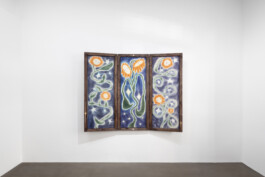
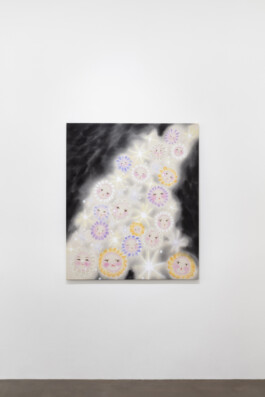
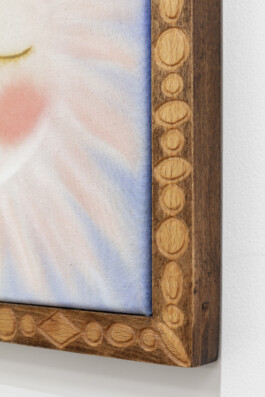
Olga Krykun, STARDUST FOR TOMORROW, 110 X 130 CM, ACRYLICS AND PASTEL ON CANVAS, 2026
Clauda is pleased to present new works by Olga Krykun in her exhibition Stardust for Tomorrow.
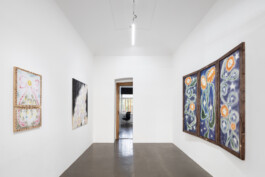
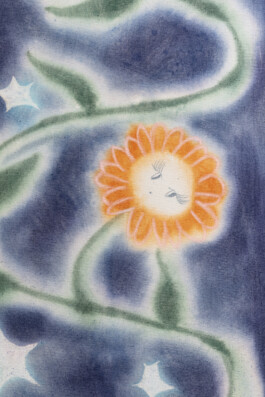
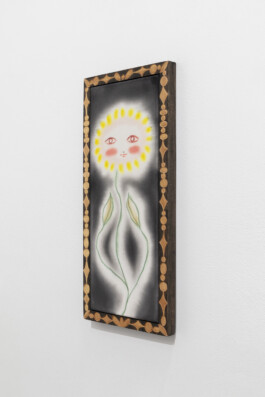
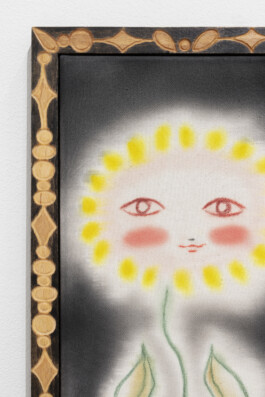
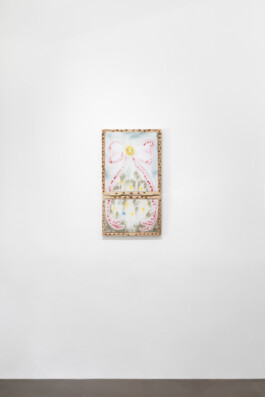
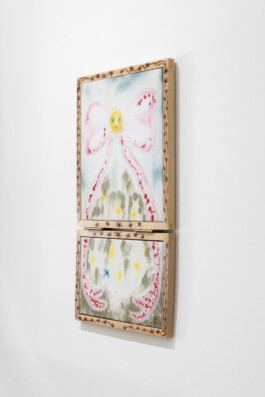
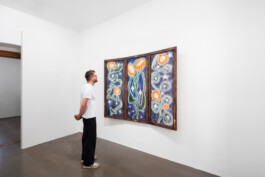
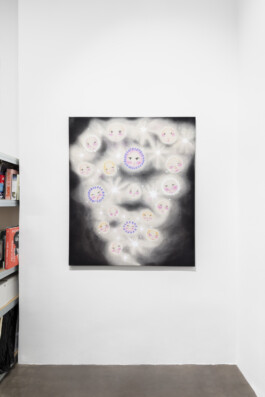
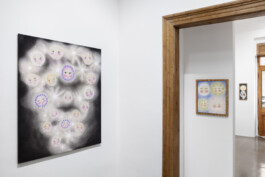
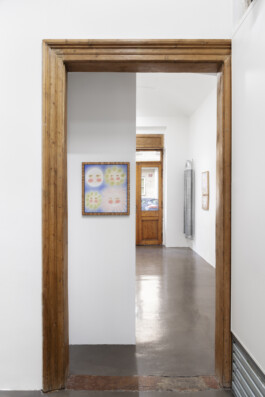
Although it may not be apparent at first glance, the smiling sunflowers painted by Olga Krykun (1994), a Czech artist of Ukrainian origin, conceal themes of war. The glittering flowers, melancholic girls' faces with smudged makeup, and fluffy dogs evoking 1990s stationery are inspired by the kitschy souvenirs that are imported from Asia by the shipload and sold at the market in Krykun's hometown of Odessa. A vision of unending war intertwines with the tacky aesthetics of Chinese trinkets in the artist's washed paintings, which symbolize childlike innocence while at the same time making an urgent, emotional appeal for individuals to bring about radical changes in our society.
While it is tempting to view Krykun's works in the context of the Japanese aesthetic of kawaii—a perspective further encouraged by her residencies in the cities of Matsudo and Yamanashi on the island of Honshu—this is not the only way to interpret them. Krykun's painterly themes confirm that this naive, unconscious cuteness must be recognized as a highly ironic and critical commentary on contemporary society. The mechanism of cuteness relies on the viewer's empathy, offering an apparent sense of security in exchange. The artist tells viewers a poetic story of comforting flowers, but upon closer inspection we discover that their stems are skeletons. Krykun's paintings remind us of something we may have forgotten: that there is a thin line between cuteness and pain. Despite the lighthearted visuality evoking digital filters used to edit selfies into a Lolita-like aesthetic of pink hues and glitter, the motifs drawn from East Slavic folklore convey serious, authentic experiences connected with the invasion and occupation of Ukraine by the Russian regime.
The work Stardust for Tomorrow, whose title became the motif of the exhibition, embodies both joy and sorrow. On the one hand, soldiers who liberate a city from a tyrant are welcomed and crowned with flowers; on the other hand, flowers are placed on their graves. Flowers are used as symbols in ceremonies of both celebration and mourning. They are a part of life and death. For 1960s hippie culture they were an emblem of peace, accompanied by the famous slogan "Flowers, not bombs." Just as flowers are fleeting, so too is dust or sand, which Buddhist monks spend days and weeks shaping grain by grain into elaborate mandala patterns, only to then scatter them with a single breath or sweep of the hand once completed. Delicate flowers and invisible stardust both evoke the Japanese concept of mono no aware, which is not far removed from the European understanding of vanitas. It is a plaintive, melancholic emotion evoked by things that are beautiful yet fleeting, such as elusive childhood memories, flowers, Chinese souvenirs, or freedom.
Emma Hanzlíková
_______________
Krykun uses a diverse array of media within her practice, including video, objects and painting, which she subsequently assembles to create complex installations. By combining elements of fictional narratives with references to cultural and socially relevant symbols, she invents a self-contradicting mythology of our day-and-age. Krykun's work is heavily informed by her experiences growing up in her family's souvenir shop during a swiftly globalizing 1990s Ukraine. Her practice, which is strongly rooted in intuition and emotion, serves as a kind of poetry for the times we live in.
Exhibitions: Gemini Season (2025), Galerie NoD, Prague (2025), 427 Gallery, Riga (2023), Wanda Gallery, Warsaw (2022), Skala Gallery, Poznań (2022), Gallery Konstfack, Stockholm (2020), and City Surfer Office, Prague (2018).
Group exhibitions: Gen-Z, MO Museum in Vilnius (2026), Ulstrup Gallery, Denmark (2025), MXM Galeria, Madrid (2025), DSC Gallery, Prague (2025), Museum of Modern Art in Warsaw (2023), Czech Centre in Seoul (2022), Garage Gallery, Prague (2021), and Yo-Chang Art Museum in Taiwan (2019).
Text: Emma Hanzlíková
Opening: June 19, 2026 / from 6p.m.
June 20 – July 18, 2026
Olga Krykun, STARDUST FOR TOMORROW, 110 X 130 CM, ACRYLICS AND PASTEL ON CANVAS, 2026
Clauda is pleased to present new works by Olga Krykun in her exhibition Stardust for Tomorrow.
Although it may not be apparent at first glance, the smiling sunflowers painted by Olga Krykun (1994), a Czech artist of Ukrainian origin, conceal themes of war. The glittering flowers, melancholic girls' faces with smudged makeup, and fluffy dogs evoking 1990s stationery are inspired by the kitschy souvenirs that are imported from Asia by the shipload and sold at the market in Krykun's hometown of Odessa. A vision of unending war intertwines with the tacky aesthetics of Chinese trinkets in the artist's washed paintings, which symbolize childlike innocence while at the same time making an urgent, emotional appeal for individuals to bring about radical changes in our society.
While it is tempting to view Krykun's works in the context of the Japanese aesthetic of kawaii—a perspective further encouraged by her residencies in the cities of Matsudo and Yamanashi on the island of Honshu—this is not the only way to interpret them. Krykun's painterly themes confirm that this naive, unconscious cuteness must be recognized as a highly ironic and critical commentary on contemporary society. The mechanism of cuteness relies on the viewer's empathy, offering an apparent sense of security in exchange. The artist tells viewers a poetic story of comforting flowers, but upon closer inspection we discover that their stems are skeletons. Krykun's paintings remind us of something we may have forgotten: that there is a thin line between cuteness and pain. Despite the lighthearted visuality evoking digital filters used to edit selfies into a Lolita-like aesthetic of pink hues and glitter, the motifs drawn from East Slavic folklore convey serious, authentic experiences connected with the invasion and occupation of Ukraine by the Russian regime.
The work Stardust for Tomorrow, whose title became the motif of the exhibition, embodies both joy and sorrow. On the one hand, soldiers who liberate a city from a tyrant are welcomed and crowned with flowers; on the other hand, flowers are placed on their graves. Flowers are used as symbols in ceremonies of both celebration and mourning. They are a part of life and death. For 1960s hippie culture they were an emblem of peace, accompanied by the famous slogan "Flowers, not bombs." Just as flowers are fleeting, so too is dust or sand, which Buddhist monks spend days and weeks shaping grain by grain into elaborate mandala patterns, only to then scatter them with a single breath or sweep of the hand once completed. Delicate flowers and invisible stardust both evoke the Japanese concept of mono no aware, which is not far removed from the European understanding of vanitas. It is a plaintive, melancholic emotion evoked by things that are beautiful yet fleeting, such as elusive childhood memories, flowers, Chinese souvenirs, or freedom.
Emma Hanzlíková
_______________
Krykun uses a diverse array of media within her practice, including video, objects and painting, which she subsequently assembles to create complex installations. By combining elements of fictional narratives with references to cultural and socially relevant symbols, she invents a self-contradicting mythology of our day-and-age. Krykun's work is heavily informed by her experiences growing up in her family's souvenir shop during a swiftly globalizing 1990s Ukraine. Her practice, which is strongly rooted in intuition and emotion, serves as a kind of poetry for the times we live in.
Exhibitions: Gemini Season (2025), Galerie NoD, Prague (2025), 427 Gallery, Riga (2023), Wanda Gallery, Warsaw (2022), Skala Gallery, Poznań (2022), Gallery Konstfack, Stockholm (2020), and City Surfer Office, Prague (2018).
Group exhibitions: Gen-Z, MO Museum in Vilnius (2026), Ulstrup Gallery, Denmark (2025), MXM Galeria, Madrid (2025), DSC Gallery, Prague (2025), Museum of Modern Art in Warsaw (2023), Czech Centre in Seoul (2022), Garage Gallery, Prague (2021), and Yo-Chang Art Museum in Taiwan (2019).